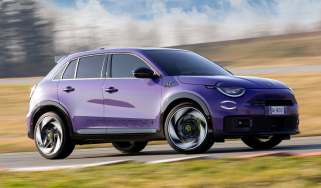
Abarth 600e review – electric hot hatch with surprising character
The Abarth 600e packs 276bhp and a fiery character, making it both the marque’s most powerful road-legal model and a genuinely entertaining driver’s car
Abarth isn’t known for producing dull cars, having been responsible for everything from aero-honed record setters to the boisterous 595 in its 75-year history.
The introduction of the all-electric 500e marked the beginning of the end for its combustion-powered models, and while bold styling and a burbling (read: annoying) fake sound generator gave it some degree of character, its lukewarm performance left us wanting more. But now, Abarth has launched the 600e and it brings a welcome dose of genuine substance to the party.
Motor and performance
- 276bhp and 254lb ft in the top-spec Competizione…
- … 237bhp in standard 600e
- 0-62mph in 5.9sec and 6.2sec respectively
If you’re familiar with the Alfa Romeo Junior you’ll have a good idea of what lies under the 600e’s skin. The 600e Competizione tops the range, taking the place of the limited Scorpionissima, with a Junior Veloce-matching 276bhp and 254lb ft of torque. It takes 5.9sec to reach 62mph from standstill, 1.1sec quicker than the smaller 500e and 1.2sec quicker than the swansong 695 combustion model.
The primary on-paper difference between the Alfa Romeo Junior and this, is that the standard 600e is available in a lower 237bhp state of tune, something that’s currently missing from the Alfa range – torque is unchanged at 254lb ft, with all underlying mechanics the same as the range-topper. The standard car takes an additional three tenths to hit 62mph (6.2sec), with a top speed of 124mph for both.
> Alpine A290 GTS review – is the Renault 5 relative a true hot hatch?
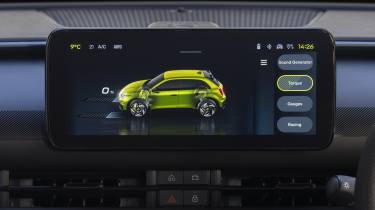
Unlike some performance cars, the 600e’s modes have a real impact on performance, limiting output to both conserve energy and provide a more relaxed drive. Turismo mode, the tamest of the three, pegs power at 110kw (145bhp) and 140kw (185bhp), Scorpion Street at 150kw (198bhp) and 170kw (225bhp) and Scorpion Track unlocking the sharpest throttle and all available power. Scorpion Track also deactivates regenerative braking entirely, making spirited driving immediately intuitive with powertrain characteristics near-identical to a combustion car, virtually eliminating the EV learning curve.
With the potent motor pulling power from the standard 54kWh e-CMP battery pack, there was some work to do in the heat management department. Stellantis engineers worked to develop a new cooling system for the powertrain for this reason, making it capable of a full lap of the Nürburgring without restricting performance (something that can’t be said for most EVs).
The more potent Competizione (formerly Scorpionissima) has extra top end pull and throttle bite on initial throttle application, but identical torque figures put the two closer in performance than the specs would suggest.
Pull does tail off after the national speed limit and up inclines on some of the undulating British B-roads we tested it on, but the 600e hits big numbers sooner than you realise. While its relatively cheap construction makes it less refined than some EVs, it masks speed surprisingly well – this is a good thing for longer, more mundane journeys, but a greater sense of speed is key to unlocking that final element of low-speed engagement we love in some of our favourite driver’s cars.
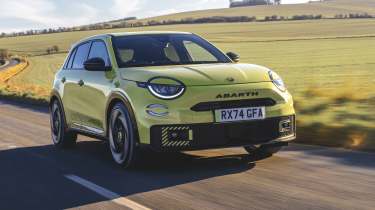
One of the Abarth’s key USPs is the interior and exterior sound generator. Fitted as standard only to the Competizione, it’s less obnoxious than the system in its smaller 500e relative, lower in volume and with a more convincing tone at idle. Revving at a standstill is still a party trick worth skipping, with the idle sound track playing constantly beneath the synthetic revs for a less convincing effect.
The sound is as loud as that of a modern hot hatchback, with no artificial gearshifts. This does make it sound a little like a CVT, but the sound is well-judged on the whole, providing a greater sense of speed than you have without it. It could be more in-tune with wheel speed, offering a greater sense of traction loss and load to further enhance feedback. In my experience, the CVT-like, gear-less sound also makes acceleration feel less dramatic than with the sound generator turned off.
A brief stint with the sound turned off on track did make it clear that the sound provides benefit when pushing on, though, acting as an additional way to gauge speed. Admittedly, we felt the need to turn it off through quiet British villages out of embarrassment, but it’s a nifty feature to have at your disposal.
Ride and handling
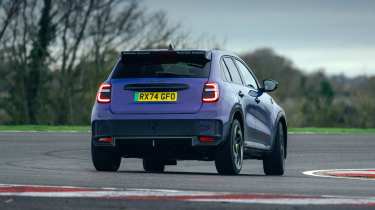
- Limited-slip diff adds sharpness and agility
- Steering feel is a welcome highlight
- ESC can’t be switched all the way off
The Abarth’s performance is delivered to the front wheels via a mechanical Torsen limited-slip differential. It’s a front-end set-up that the Abarth now shares with the Vauxhall Mokka and Corsa GSE, Peugeot 208 GTi and Alfa Romeo Junior Veloce.
There’s plenty of power to put the diff to good use even at higher speeds and on less dramatic sweeping curves, pulling you into line on the throttle where you’d usually expect an EV to wash wide.
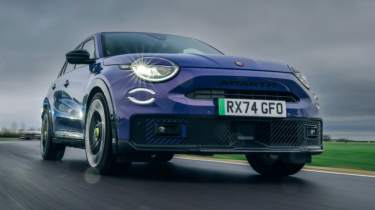
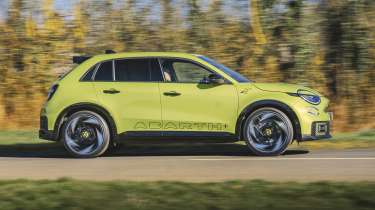
A 140 per cent increase in anti-roll bar stiffness, 41 per cent increase in suspension stiffness and a 25mm reduction in ride height over the Fiat 600e all contribute to a marked improvement in dynamic ability, with excellent composure and front-end response making it an entertaining machine. Approach the 600e from the right angle and you can spot some aggressive front camber, contributing to that alert hot hatch character.
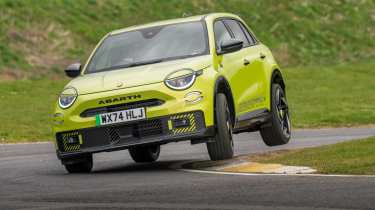
There’s no denying there’s some weight to manage, with its 1640kg kerb weight 80kg more than the Junior Veloce’s and a whole 230kg more than the 500e, but while that does put the Abarth 9bhp/ton behind the identically powerful Junior, this isn’t something you’ll notice in the real world. On the tricky British B-roads we tested it on the 600e’s firm-but-fair chassis setup is well suited to handle momentary upsets without a fuss, allowing you to carry speed with ease.
The Alcon-developed 380mm four-piston front brakes also help manage this weight, and while we would like more initial bite for added confidence, there’s plenty of stopping power available when you need it. What makes this system so special is that unlike some EVs, the most focused mode turns regenerative braking off entirely, meaning application of the brakes activates only the conventional hydraulic system.
This makes for a noticeable improvement in pedal feel and predictability, removing that soft, spongy feel of regenerative braking to inspire greater confidence on a spirited drive. The pedal did begin to lengthen after back-to-back sessions on the circuit, but we can’t imagine many buyers will use a 600e in this way.
A combination of bespoke Michelin Sport EV tyres (225-section front and rear) and uprated suspension help provide impressive lateral grip. Abarth says it can achieve more than 1 g at its peak, and we believe it, with the 600e composed and confidence-inspiring at speed. Back off the power mid-corner and it’s easy to induce predictable rotation, with the setup playful and adjustable on the throttle.
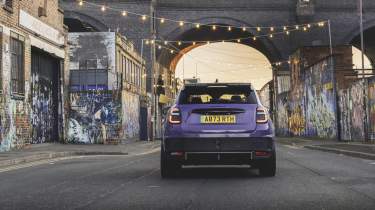
Ride is as firm as you’d expect from an Abarth. Hydraulic bump stops help improve ride at the limit, and while it’s certainly not the most cosseting of cars, it’s confident and compliant, with bumps dealt with quickly and concisely.
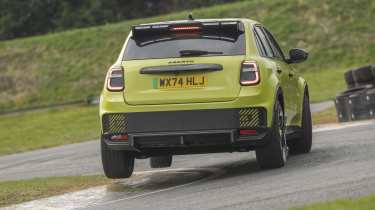
While we’re yet to test them back-to-back, Abarth says it has the edge over its Alfa Junior relative in this department too, thanks to a thicker 19mm (versus 17mm in the Alfa) rear anti-roll bar for an increase in rear end stiffness – out on Ancaster karting circuit during the UK launch, lifting not one, but two wheels was a regular occurrence.
Steering is also best in class, with well judged weighting and a good dose of feedback providing a great sense of front end connection. This also makes it considerably easier to gauge the effectiveness of that mechanical front differential, with it sending a meaningful kick through the wheel on power application as it brings the front in line. It manages it without being overly hyperactive, too, with well-judged response.
Bedford track test – Yousuf Ashraf
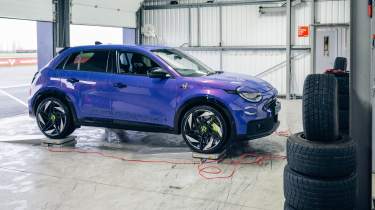
‘Dynamically the Abarth feels firm, responsive and keen to change direction. The steering is positive and firmly weighted and it goads you into bullying it around the lap, though when you do it does feel taller and a little less wieldy than an Alpine A290, with more inertia in its movements (at 1665kg it’s the heaviest car here).
‘There’s less polish in the controls too – specifically in the brake pedal, which has a longer and much less reassuring throw than the Alpine’s.
Pick up the pace and there’s a sense of neutrality to the Abarth, and it does feel purposeful in terms of the control of its suspension and its keen responses. It feels like a performance product, rather than just a faster Fiat 600e. Which makes it all the more frustrating that the stability control holds the car on a tight leash and can’t be permanently switched off (it automatically turns itself back on at speed).
‘Any hint of playfulness or yaw is reined in, the ESC grabbing at the brakes to kill the fun, and your momentum. The best way to make progress in the 600e is by underdriving so that the electronics don’t intrude, which feels wrong in a hot hatch and ultimately makes it less fun and less expressive than some other hot hatches.’
Range and efficiency
- Strong performance and serious tyres hit the range
- 207 miles claimed range, closer to 120 across a spirited drive
- 100kW charge speed isn’t that fast, but 54kWh isn’t much battery
One of the 600e’s biggest downfalls is its range, as while it has all of this extra performance, its 54kWh (51 usable) battery pack is no larger than that of an ordinary Fiat 600e. The result is a 207-mile WLTP combined range estimate, which drops in real world use on not-so-efficient British back roads.
Our time in the 600e saw charge drop by well over 10 per cent on a short 10 minute spirited run, with average efficiency of just above 1 mile/kWh. An hour-long spirited drive on undulating British B-roads saw quoted efficiency at 2 miles/kWh, which is better, but still poor. While these were hardly an everyday drive, this goes some way to proving how poor the range can be when using the performance on offer.
Peak charging speed isn’t the best but the class as a whole has yet to leap much higher. It comes in at just 100kw at compatible stations. Granted, its 54kWh battery pack is smaller than most and so will take less time to fill as a result, but a quicker fast charging speed would be nice to have given its ability to quickly drain the battery.
Interior and tech
- Standard Fiat 600e cabin components…
- … though premium materials and Sabelt seats elevate it
- Digital user interface not the most intuitive
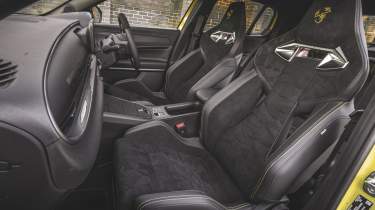
As you’d expect, there are many similarities to the ordinary Fiat 600e inside, but Abarth has spent a good amount of time adding its own touch. Opt for the Competizione and supportive, sculpted Sabelt seats are standard-fit, with unique cut outs similar in style to those seen in the F80 BMW M3. While they do hold you in place in high-load corners, they suffer from the same ‘sat on’ feel as Sabelt seats in previous ICE Abarths. Regardless, we much prefer them to the alternatives in the standard car which are more basic in terms of design and support, and all seat options drop lower than you might expect to help you find the ideal seating position.
In the range-topper, there are also numerous Abarth-specific touches throughout the cabin including a dashboard decal and (admittedly cringeworthy) ‘Mind the scorpion’ text on the Alcantara cover for the capacious central cubby. The standard car goes without many of these features, making it feel significantly more mundane inside – this is especially the case in the rear, where there are zero indicators that you’re sitting in an Abarth. That’s not to say you’ll spend much time in the back, with very little available leg room for average adults. The seats do feature knee cutouts for a bit of extra leeway, but long journeys in the back won’t be comfortable for most.
While it shares a platform and powertrain with the Alfa Romeo Junior, the Abarth doesn’t suffer from some of the same ergonomic quirks. The 600e opts for gear selection buttons below the infotainment display as opposed to the ubiquitous notched selector in many other CMP models, and its central 10.25-inch display is mounted in a much more pleasant raised position.
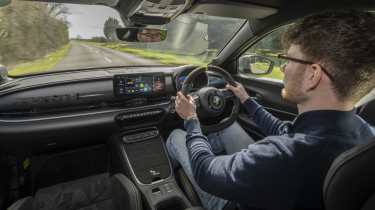
The twin-spoke steering wheel is upholstered in leather and Alcantara as standard, with a yellow 12 o’clock marker and stitching matching the rest of the cabin – frustratingly the Alcantara features only on the top and bottom of the wheel as opposed to where you ordinarily place your hands, but long-term owners will likely appreciate this decision from a wear perspective. The wheel doesn’t quite move low enough for my driving position, with less articulation than in some rivals.
One of the cabin’s major letdowns is the seven-inch digital instrument display. While speed and remaining battery are front and centre, any other information is either minuscule, obscured or hidden behind complicated menus. While there are improvements over the 500e such as the ability to change exterior sound more easily via the infotainment display, the UI is inferior in many ways to even combustion Abarth models launched over a decade before. Abarth is also yet to develop an uprated speaker option for the 600e, and while the standard system is adequate, this will be a frustration for some.
Overall, the Abarth 600e’s cabin doesn’t feel quite as well finished as its Alfa sibling, with more high-sheen, hard plastics on the upper levels and a few rattles to note. Nevertheless, it’s more than fit for purpose, and while we’d opt for the Competizione for its extra standard kit, the Abarth touches also make a real difference to lifting the aesthetic of the Fiat on which it’s based.
Price and rivals
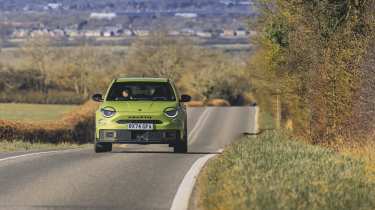
The Abarth 600e now benefits from the government’s £1500 electric car grant, taking the price of the Turismo entry-spec car down to £33,995, which trades the sound generator, an electric tailgate and the supportive Sabelt bucket seats for a lower price tag. What was Scorpionissima spec is now Competizione spec, for £37,995, boasting more power, unique interior touches and virtually all kit as standard, with all UK cars essentially one spec. The Scorpionissima was a launch model limited to 1949 units.
The Alpine A290 gets the full £3750 government electric car grant and that drops prices significantly. A GT Performance, formerly £36,000, can now be had for £32,745 and a GTS for £34,245. There’s also the option of the 254bhp Mini John Cooper Works Electric for £34,905. Then there’s the £42,295 Alfa Romeo Junior Veloce and £36,995 Vauxhall Mokka GSE that are near-identical under the skin.
The Cupra Born V2 offers much better range at 385 miles but is more expensive at £39,995 and not as engaging as the 600e. If you can stomach its range, the hot 600e is an excellent first step into the EV world for keen drivers, offering an engaging drive and some of that classic Abarth character we’ve all come to love.
Abarth 600e specs
| Turismo | Competizione | |
|---|---|---|
| Powertrain | Single-motor, front-wheel drive | Single-motor, front-wheel drive |
| Battery | 54kWh (51kWh useable) | 54kWh (51kWh useable) |
| Power | 237bhp | 276bhp |
| Torque | 254lb ft | 254lb ft |
| 0-62mph | 6.24sec | 5.85sec |
| Top speed | 124mph | 124mph |
| Weight | 1624kg (146bhp/ton) | 1640kg (168bhp/ton) |
| Range (WLTP combined) | 200 miles | 199 miles |
| Price (Including ECG) | £33,995 | £37,995 |