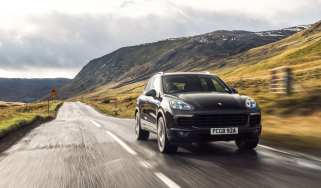
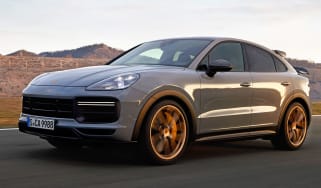
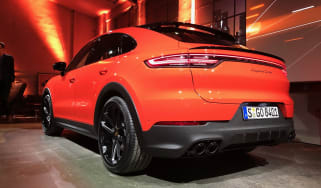
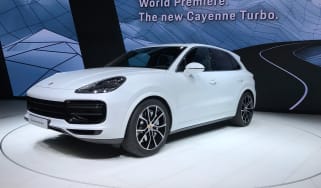
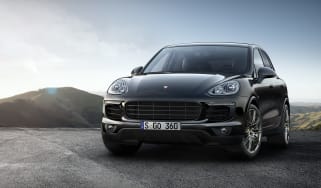
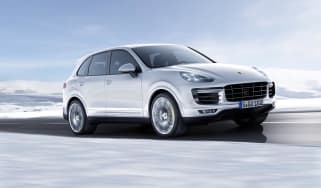
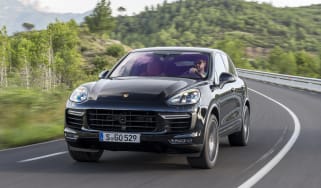
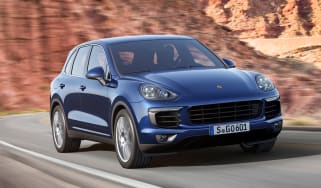
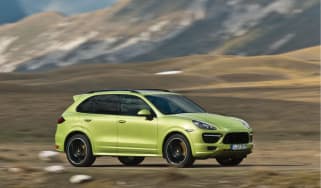
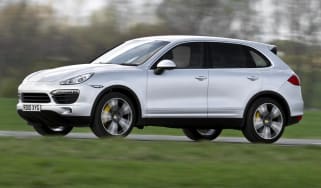
Porsche Cayenne review – sharper than a Range Rover Sport, but more desirable?
The Cayenne continues to be one of the most dynamically capable SUVs in its latest guise. It needs specific options to deliver its best, however, and the Range Rover Sport has it beat for luxury

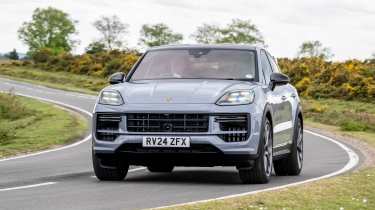
The Porsche Cayenne isn’t the trailblazer it once was. Not because it’s got any worse over the years, but because other manufacturers have caught on to its winning formula. The original, along with the BMW X5, was one of the first SUVs engineered to be enjoyable and dynamic to drive (as incongruous as that sounds), but today there’s no shortage of rivals that offer the same, from the Range Rover Sport and Audi Q8, right up to the Aston Martin DBX and Lamborghini Urus.
In other words, the Cayenne’s USP isn’t exactly unique anymore, but that’s not to say it isn’t a compelling package in its own right. For a big SUV sharing its underpinnings with other VW Group cars like the Urus and Bentley Bentayga, it does a good job of capturing Porsche DNA in the way it drives and how it's put together. Models like the Turbo E-Hybrid GT Package even promise to deliver some level of track ability, with supercar power levels.

The current, third-generation Cayenne first appeared in 2017, and in 2024 it was subject to a comprehensive update levelled at its styling, cabin, powertrains and chassis. While an all-new electric Cayenne was launched in 2026, the ICE version we’re testing here continues to be sold alongside it, following the same strategy as the smaller Macan. The question is, does the petrol Cayenne still hold the essential appeal that’s helped it stand out over the years, or is it starting to feel out of date?
Engine, gearbox and technical highlights
With the Volkswagen Group’s MLB Evo platform at its core, the Cayenne is related to the Bentley Bentayga and Lamborghini Urus, but that’s not to say all three feel the same to drive. Porsche has instilled the Cayenne with its own dynamic character through bespoke suspension hardware and software tuning, and in the latest model this is facilitated by dual-valve PASM adaptive dampers. With separate valves for compression and rebound, these units claim to offer better ride quality and control, and they’ve been calibrated to offer a wider range of adjustment than before. Steel springs are standard, with two-chamber air suspension available as an option, along with mechanical torque vectoring, rear-axle steering and active anti-roll bars.
More reviews
In-depth reviews
- New Porsche Cayenne Electric review - Bugatti performance in an SUV… but why?
- Used Porsche Cayenne (2010-2017) review – not the prettiest SUV, but a remarkably capable one
Reviews
- Porsche Cayenne Coupe Electric review – Ferrari Luce too pricey? Porsche has a solution
- Porsche Cayenne GTS Coupe 2024 review – the SUV that might tempt you out of an RS6
- Porsche Cayenne Turbo GT (2021-2023) review – can it take on the Aston Martin DBX707?
- Porsche Cayenne Turbo S E-hybrid review - more is more, is less
- Porsche Cayenne Turbo review and pictures
- 2013 Porsche Cayenne S Diesel review
The Cayenne’s range of petrol and plug-in hybrid powertrains received power and efficiency upgrades as part of a facelift a couple of years ago, with an eight-speed torque-converter gearbox featuring across the line-up. A 3-litre turbocharged V6 remains in the base car, albeit with a boost to 348bhp and 369lb ft of torque (up by 13bhp and 37lb ft respectively). In the Cayenne E-Hybrid, the V6 is supplemented by a 174bhp electric motor integrated into the driveline for a combined 464bhp and 479lb ft. As well as the power hike, facelifted hybrid Cayennes receive a significantly larger 25.9kWh battery pack in place of the previous car’s 17.9kWh unit, enabling a longer electric range of up to 52 miles.
For the latest model, the Cayenne S effectively replaces the Turbo; its 4-litre twin-turbo V8 generates 468bhp and 443lb ft. Confusingly, the Cayenne S E-Hybrid doesn’t feature an electrified version of this engine, but rather a V6 hybrid setup with 512bhp and 553lb ft.
Next up is the GTS, which takes the pure-V8 S as a base but adds driver-focused upgrades like 10mm lower air suspension, retuned dampers, front axle pivot bearings and more negative camber at the front. Porsche's Torque Vectoring Plus is also included, and the GTS's V8 is uprated to 493bhp and 487lb ft.
Due to tightening European emissions regulations, the stunningly capable Cayenne Turbo GT model is no more, but it’s been replaced by the altogether more mighty 729bhp Cayenne Turbo E-Hybrid. That colossal output is achieved by combining a 4-litre twin turbo V8 with an electric motor, and while the Turbo E-Hybrid isn’t technically supported by Porsche’s GT division, it is offered with a £21,300 GT Package to convert it into a hardened super-SUV. Exclusively available with the fastback Coupe model, this brings new geometry, bespoke front suspension pivot bearings, a 10mm ride height drop and carbon ceramic brakes, along with active anti-roll bars and rear wheel steering. A carbonfibre roof and diffuser – plus a twin-exit titanium exhaust system – echo the old standalone Turbo GT.
No amount of carbon parts makes a meaningful dent in the Cayenne’s kerb weight though, which stands at 2055kg in its lightest form. Hybrid models push this beyond 2.4 tons – par for the course in this class, but still enormously heavy.
Driver’s note
‘Jumping from a base Cayenne to one with rear-wheel steering, torque vectoring and PASM air suspension, you realise how much work those systems are doing to hide its mass and quicken its reactions. The standard car is fundamentally sound but the optional extras really do make an enormous difference to its dynamics.’ – Yousuf Ashraf, evo Senior Staff Writer
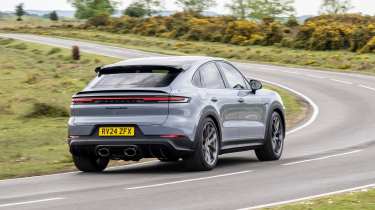
Performance, ride and handling
Even in base form, the Cayenne is deceptively fast. Wind up the V6 and it feels hot-hatch quick, reaching 62mph from rest in 6sec with a distant (if slightly coarse) crescendo towards the 6500rpm red line. It’s not a particularly inspiring engine, but it’s a flexible unit with enough mid-range pull for effortless daily driving, and the gearbox shuffles through its eight ratios smoothly in the background. Take manual control and the shifts don't hit home with the immediacy of a PDK ‘box, but there isn't a yawning delay either.
The numbers only get more impressive from here though, with the E-Hybrid reaching 62mph in 4.9sec. That’s a figure that would trouble most hot hatches, but while the hybrid system does give the Cayenne added strength and flexibility – particularly at the low end – it doesn’t do anything for the V6’s character, which still sounds a bit strained at higher revs.
The non-hybrid S completes the same sprint in 5sec, with the GTS cutting this down to 4.7sec, matching the S E-Hybrid. The flagship Turbo E-Hybrid, meanwhile, completes the benchmark in a blistering 3.7sec, running onto a 183mph top speed.
The 729bhp Turbo E-Hybrid is the most powerful Cayenne ever built, and predictably, it's ballistic. You can feel that the powertrain is working hard against the car's mass (a considerable 2495kg), but traction is formidable and there's huge muscle from low revs. Once the V8 hits its stride it piles on speed effortlessly.
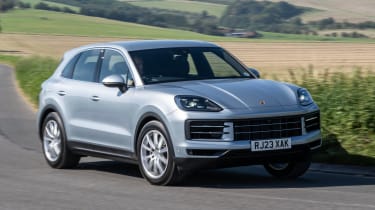
In base form without rear-wheel steering, active anti-roll bars and air springs, the Cayenne doesn’t conjure the exceptional response and control we know this platform can achieve. There isn’t the physics defying sharpness and agility of the very best fast SUVs (or Cayennes for that matter), but that isn’t to say its inherent dynamic ability doesn't rise to the surface.
Even without the chassis gizmos it feels linear and intuitive, with remnants of sporting DNA in its makeup. The clean, consistent steering feel allows you to trace a precise line along sweeping roads, with a measured rate of response as you wind on lock. The brakes are easy to modulate and picking a road apart feels natural, and while the Cayenne never completely shakes off its sense of size and weight, the forces at play feel expertly controlled.
This is partly due to the new damping technology, which (true to Porsche’s word) does offer a significant difference between each mode to suit the conditions. None of them feels overwrought – switching to Normal sets the car into a relaxed stride with an acceptable degree of vertical float, with Sport mode dialling this out for a more immediate, controlled reaction to bumps.
It’s a well-judged compromise, but even at its softest the Cayenne doesn’t feel quite as plush as other more overtly luxurious SUVs. There’s more road noise than you might expect and some poor surfaces do patter through the chassis, which is amplified in Sport mode.
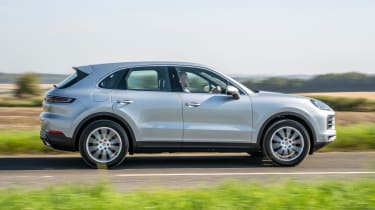
The GTS – with rear-wheel steering, PASM air suspension and Porsche Torque Vectoring Plus – delivers the almost freakish supersaloon-on-stilts feel that the third-generation Cayenne is capable of. In its agility, throttle adjustability and steering precision it moves the game on massively from the base spec car without options, with a poise that few performance SUVs can match.
With the GT Package the Turbo E-Hybrid is a formidable performer, combining this dynamic strength with a monstrous 729bhp kick from its electrified V8. It feels like a heavy-set machine, but the sophisticated chassis tech makes it grippy and responsive to your inputs, and even throttle adjustable on the way out of corners. It's not especially plush and doesn't float along with the grace of a Range Rover, but it feels remarkably keyed into the road for an SUV.
Driver’s note
‘The Turbo E-Hybrid GT Package isn’t exactly a deft, delicate performance car, but its capability is astonishing. The hybrid system gives it sharp response and there’s explosive acceleration when the V8 hits its stride. You never escape its sense of mass but it feels taut, tightly controlled and almost freakishly agile as it bullies its way along a road.’ – Yousuf Ashraf, evo Senior Staff Writer
MPG and running costs
On a mixed 200-mile route of town driving, B-roads and motorways, we averaged 33.2mpg in the standard V6 Cayenne, which beats Porsche’s official figure by 6mpg. That’s a respectable result for a V6 petrol-engined SUV that weighs over two tons.
With a larger twin-turbo V8, the Cayenne S and GTS don’t fare as well. Porsche quotes 23mpg on the WLTP cycle, which is slightly worse than the storming BMW X5 M60i with its 4.4-litre turbocharged V8.
The PHEV models offer up to 52 miles of electric range and much improved efficiency, although how close you get to the E-Hybrid’s claimed 71.7mpg figure will depend on what kind of driving you do and how regularly you charge the battery. The Turbo E-Hybrid has a slightly shorter 48-mile electric range and officially achieves 59mpg.
The inevitable cost of running a big heavy SUV on such substantial hardware will make itself known once consumables like tyres, brake pads and bushes start wearing, but on the upside the Cayenne's residual values are historically strong, taking some of the sting out of ownership costs.
Interior and tech
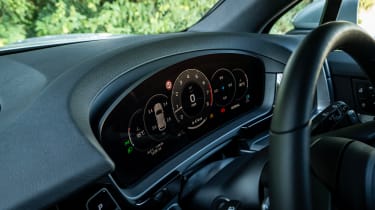
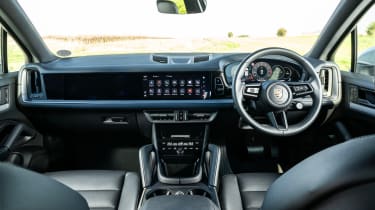
The Cayenne draws from the Taycan for its cabin design and tech, and some elements are a clear step on from the pre-facelift car. The new, curved 12.6-inch instrument panel is more configurable than before, offering a suite of digital dials that mimic the analogue clocks from Porsches of old.
Meanwhile the central 12.3-inch touchscreen offers intuitive menus and fast response times, and combines with an optional 10.9-inch passenger display to deliver an extraordinary number of pixels to your eyeballs. The technology feels current and befitting of a high-end SUV, and yet somehow the overall ambience lacks the rich, luxurious feel of something like a BMW X5 – not least a Range Rover Sport.
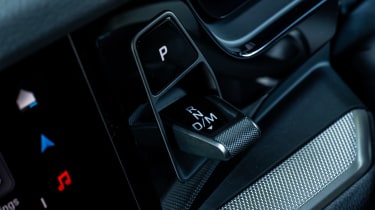
Overall the design and material choices feel a little plain. Aside from the knurled climate control switches on the centre console, finely crafted, attention-grabbing details are few and far between. Optional extended leather and trim upgrades do lift it but it still doesn’t feel especially plush or distinctive. We’re not entirely convinced by the dashboard-mounted gear selector switch either, which is more difficult to reach and less satisfying to use than the old pistol-grip lever between the seats.
The fundamentals – such as the driving position, ergonomics and overall build quality – are among the best in class though. Overall it’s a well made, well laid out and very spacious cabin – if a little bland for the price.
Price and rivals
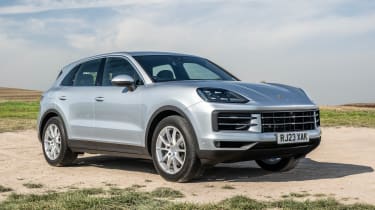
The Cayenne covers a huge area of the SUV market, with the base car priced at £77,500 and the Turbo E-Hybrid Coupe GT Package costing a rather frightening £166,100. That gives it an awful lot of rivals to contend with, but there’s enough breadth and ability in the package to take them on with confidence.
The Cayenne’s most obvious rival is the Range Rover Sport, which costs from £76,430 in diesel S form. The new Sport has enormous bandwidth with a calm, luxurious feel and saloon-like dynamics all in one package, but like the Cayenne, it needs some optional chassis hardware to give its best (namely the £5330 Stormer Handling Pack). The BMW X5 also has the Cayenne firmly in its sights, costing from £75,780 and packing thoroughly modern tech and a compelling range of engines.
Stretching to the GT Package-equipped Turbo E-Hybrid opens up a new realm of super-SUV competitors, including the brilliant Land Rover Defender Octa, Range Rover Sport SV, Aston Martin DBX S and Bentley Bentayga. The previous Turbo GT had spectacular speed and ability for its size, and the even more powerful Turbo E-Hybrid pulls the same trick – although moments where you're able to use the full extent of its capability are few and far between.