Porsche 911 Cabriolet review – going top-down is no longer a compromise
Almost as fast and dynamic as the coupe (and less blustery than the Targa), the 911 Cabriolet is one of the most accomplished convertible sports cars you can buy

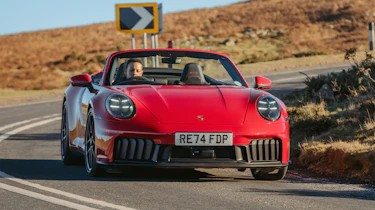
There really is a Porsche 911 for everyone these days. The current 992.2 range is becoming more diverse by the day, with six core Carrera models – including the manual Carrera T, and the hybrid-powered GTS – a GT3 in either winged, Touring or drop-top S/C spec, plus the electrified, 700bhp+ Turbo S. On top of this there are three body styles to choose from: coupe, Targa and the model we’re covering here, the Cabriolet.
The Cabriolet first appeared in the 911 range back in the latter days of the SC model in the 1980s, and has been a staple ever since. Today it sits alongside the Targa as one of two open-air 911 bodystyles, using a folding soft top instead of the Targa’s complex metal and glass arrangement. It’s a more traditional, fully open style of convertible and as we’ll get to later, has its benefits over the Targa format.
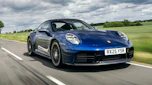
Normally less rigid and heavier than their tin-top counterparts, a convertible wouldn't often be your first choice for a precise, focused sports car, but times are changing. Manufacturers have become more adept at working around the shortfalls a chopped roof brings, particularly in terms of structural rigidity and refinement. As such, Porsche is confident it can deliver a pure 911 experience without a roof, to the extent that it's applied the GT3 name to a Cabriolet for the first time ever – the S/C – for the 992.2 model. Here we find out whether the Cabriolet really is a no-compromise open-top 911.
Engine, gearbox and performance
- Wide range of flat-six engines, from 389bhp Carrera to 701bhp Turbo S
- All aside from Carrera T and GT3 S/C are PDK-only
- GTS and Turbo S pack hybrid power, including electrically-driven turbos
More reviews
In-depth reviews
- Porsche 911 Carrera GTS review – why Porsche's T-Hybrid is also one of the best
- Porsche 911 Targa review – the opposite of a purists 911, but still superb
Long term tests
Reviews
- Porsche 911 Turbo (930, 1974 - 1989) review – when Germany took on Italy’s icons
- Porsche 911 Challenge review – this £200k racer might be the most fun 911
- Gunther Werks Turbo review – part Porsche 911 Turbo, part hypercar
- Porsche 911 GT3 S/C review – does a convertible GT3 really make sense?
- Porsche 911 (992.2) GT3 Manthey Kit review – a road-legal race car with a warranty
- Porsche 911 GT3 RS Manthey kit review – the ultimate Nürburgring toy tested to the limit
All 911 Carrera models are available as Cabriolets, plus the Turbo S and – strange as it is to say – the GT3. Engine specs are the same as coupe counterparts, but given Cabriolets weigh around 80kg more, their performance is blunted slightly. Less so in the case of the GT3 S/C, however, which thanks to extensive lightweighting comes in at just 36kg more than a GT3 Touring. All Cabriolets come with an eight-speed dual clutch PDK gearbox, bar the six-speed manual Carrera T and GT3 S/C.
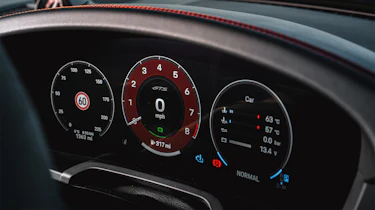
The Carrera, Carrera T, Carrera S and Carrera 4S Cabriolets use 3-litre turbocharged flat sixes, with the base and T models generating 389bhp and S models getting 473. The GTS and Turbo S Cabriolets use a larger 3.6-litre unit supported by a hybrid system, with a gearbox-integrated electric motor and electric turbocharger technology (the GTS getting a single turbo, the Turbo S having two).
In truth, the GTS could pass as a Turbo with its effortlessly punchy delivery and broad power band. It’s a fantastically quick car, its 534bhp – and more pertinently, 450lb ft of torque – giving it enough instantaneous shove that you’re never aware of the marginal performance gap to the coupe. The hybrid system is seamlessly integrated, covering for most of the lag from the single turbocharger to improve response and retaining the linear delivery that you’d expect from a naturally aspirated engine – just with heaps more muscle throughout the rev range. The sound is a little synthetic at higher revs but there’s a gravelly tone when cruising that’s reminiscent of an air-cooled 911, and actually quite characterful.
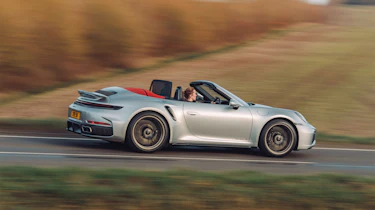
The Turbo S has less of a raw edge to the sound but more turbo noise, and an even stronger hit of performance. Fully wound up it’s intensely fast, and so efficient in how it deploys its 701bhp. All 911s put their power down superbly well but the Turbo is even more impressive, given how it generates stunning forward thrust with so little drama. This is helped by the PDK gearbox which, as in lesser models, delivers fast and clean shifts – if not the absolute sharpest compared to, say, a Ferrari.
Being naturally aspirated with a manual gearbox, the GT3 S/C has slower acceleration times than all Cabriolets bar the base Carrera and Carrera T (the latter of which is the slowest accelerating 911 you can buy), but the fact that it’s a pure analogue creation is worthy of celebration.
Driver’s note
‘The Turbo S is undramatic in a way, since even with the roof down the engine doesn’t have a hard-edged soundtrack, but the accelerative force is startling at kick-down, and is sustained through the gears and the full sweep of the rev band. It’s worth holding on for the last 1000rpm too, as the thrust intensifies right up to 7000rpm.’ – Yousuf Ashraf, evo Senior Staff Writer
Porsche 911 Cabriolet specs
| Model | Power | Torque | 0-62mph | Top speed |
| Carrera Cabriolet | 389bhp | 332lb ft | 4.1sec | 181mph |
| Carrera T Cabriolet | 389bhp | 332lb ft | 4.7sec | 182mph |
| Carrera S Cabriolet | 473bhp | 391lb ft | 3.5sec | 191mph |
| Carrera GTS Cabriolet | 534bhp | 420lb ft | 3.1sec | 194mph |
| GT3 S/C | 503bhp | 332lb ft | 3.9sec | 194mph |
| Turbo S Cabriolet | 701bhp | 590lb ft | 2.6sec | 200mph |
Ride and handling
- Minimal compromises compared to the coupe, with almost the same dynamic ability
- A little noisier and busier than the coupe on rough roads, but not much
- Four-wheel drive models are more secure while still being playful
Compared to the previous 991 generation, the 992’s structure boasts a much greater use of aluminium – over 60 per cent – and much higher structural rigidity. This strength does wonders for the Cabriolet’s dynamics, which aren’t quite as crisp as the hard top’s, but get impressively close. From the moment you move off there’s precision and sharpness to the Cabriolet’s responses, and it feels as far from a lazy, laid back convertible as you could imagine. It feels like a proper sports car, like a 911 – only lacking a touch of immediacy and incisiveness, which you’d need prior experience of a coupe to notice.
On most surfaces the structure feels rock solid. There’s a little more vibration through the Cabriolet’s steering rack but nothing to muddy its feel too much, and on rough roads you notice more of a tremor as the suspension deals with surface patchwork. By and large though the Cabriolet doesn’t give up much to the coupe in its dynamics, and gets closer than the heavier Targa. It’s noticeably less blustery and more refined than the Targa at speed, too, not suffering from the same turbulence at 50mph and above. The Cabriolet cruises calmly with the roof down at motorway speeds, and with the roof up, isn’t much noisier than the coupe. 911s aren’t exactly hushed to begin with and they generate a fair bit of road noise, which makes the Cabriolet’s extra decibels less noticeable.
All Cabriolets come with PASM adaptive dampers as standard, and there are additional dynamic extras – including carbon ceramic brakes and PDCC active anti-roll control – available. The GTS gets a unique, more focused chassis tune, with the Turbo S getting the most sophisticated chassis tech with electrohydraulic roll stabilisation, which takes advantage of its 400-volt electrical system. All that tech comes at a price, chiefly in terms of weight. While the base Carrera comes in at 1600kg, the Turbo S Cab is the heaviest 911 available, at a chunky 1810kg.
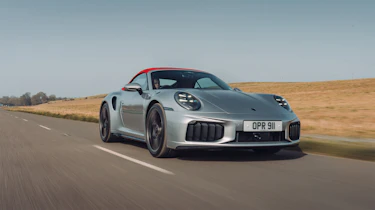
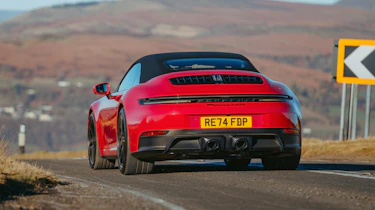
The GTS is substantially lighter at 1675kg in rear-drive form, and it has the same gritty edge that makes the coupe so enjoyable. In everything from its powertrain to the steering and chassis it’s sharp, immediate and has a sense of focus that very few mainstream convertibles do. It feels connected to the surface, particularly at low speed where the ride can be choppy, but add speed and the GTS finds its flow, the body staying level and superbly controlled.
You can guide it along with real confidence, and when the mood takes you, there’s a playful side to its character to be explored. Even the 4 GTS is a mobile and entertaining car, the four-wheel drive system adapting to your driving beautifully. Out of hairpins the rear slings wide as in a rear-drive car, the front axle helping you if the angle gets too big, and at speed it’s reassuringly stable. The only slight snag is the brakes. They have power to spare but the initial bite could be firmer and more reassuring.
The Turbo S Cabriolet has a more polished (but still firm) ride quality, less of a raw edge to its driving experience. The roll control system keeps the body level through direction changes and allows the car to corner with remarkably little fuss, hooking into corners precisely and driving out of them without wasting a scrap of its 701bhp. In terms of capability it’s hard to pick holes in, but it’s a less engaging car than the GTS. That probably won’t matter to most buyers, since the Turbo S satisfies its brief as a usable convertible supercar with phenomenal all-round capabilities, but ballistic straight line performance aside, it’s not the most memorable.
Driver’s note
‘The Turbo S Cabriolet is a multi-talented supercar with very few compromises, but for over £60,000 less the GTS is a more charismatic car, that’s still as livable – and blindingly quick – as most people would need. It may be the most powerful and expensive 911, but the Turbo S Cab isn’t the one we desire most.’ – Yousuf Ashraf, evo Senior Staff Writer
Interior and technology
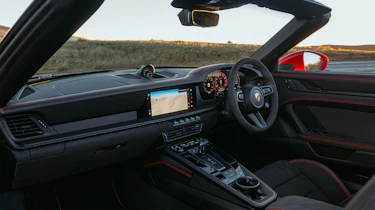
The 911’s cabin blends a modern, sharp and intuitive infotainment system with solid ergonomics, and doesn’t resort to touch controls to declutter the interior. With that said, the latest model loses the analogue rev counter and the pistol-grip shift lever of previous generation, and some character with it.
The driving position is highly adjustable and it’s easy for drivers of all shapes and sizes to get comfortable, although the Cabriolet’s high rear deck means the glass window is little more than a letterbox, and rearwards visibility is at times marginal. The roof lowers with a simple depress of a button on the centre console, and buffeting with it lowered is notably contained, even without raising the wind break.
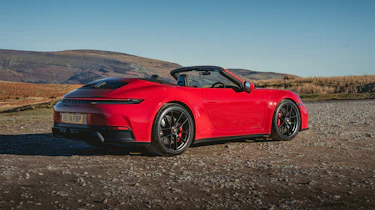
More compact and lighter than the roof module in the previous-gen 991 Cabriolet, thanks to the extensive use of magnesium and aluminum, the fully electric soft top opens and closes in just 12 seconds, and at speeds of up to 31mph. Porsche is particularly proud of how it maintains the roof profile of the coupe model. Behind the occupants’ heads is an electrically-operated wind deflector and a roll over protection structure that deploys automatically should the car detect you’re about to have an almighty accident.
Price and rivals
While the 911 punches above the sports car class in terms of its performance and dynamics, it no longer feels like a relatively affordable option in monetary terms. The Carrera Cabriolet starts from a punchy £113,700, and from there prices quickly rise: you’ll pay £125,400 for the Carrera T, £130,500 for the Carrera S and £147,900 for the GTS. The GT3 S/C, meanwhile, costs £200,500, with the Turbo S being the most expensive 911 on sale at £209,000.
That makes the Cabriolet a rival to everything from the BMW M4 Convertible and Morgan’s Supersport, to GTs like the Maserati GranCabrio and Aston Martin Vantage Roadster, and at the top level, full-blown supercars like the Maserati MCPura Cielo and McLaren’s Artura Spider. The 911 is accomplished enough to go toe-to-toe with any of the above, but bespoke supercars do offer more distinctive and exciting characteristics than the Turbo S at the £200k bracket. We haven’t driven it yet, but we’d bet on the GT3 S/C addressing that concern.