Maserati MCPura review – the modern-day Ferrari F40
The Maserati MC20 took top honours at evo Car of the Year 2022, but since then it’s been overshadowed by McLaren and Ferrari’s latest and greatest. Does its replacement – the MCPura – put that right?

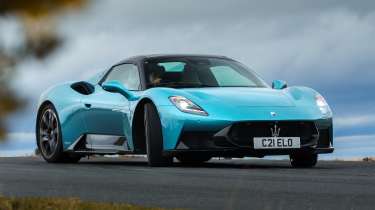
Back in 2022, on the Scottish borders in mixed conditions against the very best that McLaren, Ferrari and Porsche had to offer, the Maserati MC20 stole our hearts and won evo Car of the Year. Where did that come from? At the time Maserati was only offering the ageing GranTurismo and underwhelming saloons and SUVs, and out of nowhere came this completely bespoke and utterly bewitching carbon-tubbed creation with shades of Ferrari F40 in its character. No motors, no batteries, just an unadulterated and pure supercar in an increasingly digital age. It was brilliant. Maserati was back.
Or was it? Despite carrying the afterglow of that eCoty win, later MC20s we’ve driven haven’t quite captured the magic we found in 2022. The bombastic personality remained but a lack of finesse was evident against more modern and polished rivals like McLaren’s brilliant Artura. The MC20 was and still is a stellar supercar, but as time has gone on its flaws have become more apparent, and you need to look past them to appreciate its brilliance.

The MCPura is Maserati’s chance to get back on top. It’s an updated MC20 in all but name, and supposedly leans into that car’s role as a daily usable supercar, an aspect that Maserati says took some customers by surprise. As such the styling has been tightened up, the interior has been updated…and not much else. Maserati says that in the interest of preserving the MC20’s approachable nature, no changes have been made under that carbon skin – the MCPura’s mechanicals are identical, but we wouldn't be surprised if engineers have made hidden tweaks to software and calibration systems while they had the chance.
More reviews
Group tests
- Ravage Alpine A110: France's perfect sports car made even more perfect
- Alpine A390 v Hyundai Ioniq 5 N – are these EV crossovers fun as well as fast?
- Lotus Emira Turbo SE v Alpine A110 GTS – two of the last surviving mid-engined sports cars
- Ariel Atom 4R v Ariel Nomad 2 – is grip more fun than slip?
- Ariel Atom 4R v Caterham Seven ‘evo25’: power-to-weight heroes go head-to-head
- Ariel Atom 4 v Caterham Seven 310R v Lotus Elise Cup 250
- Audi Quattro, RS2 and RS3: five-cylinder icons head-to-head
- Who makes the best GT car? Aston Martin v Bentley v Maserati
- Caterham Super Seven 600 v Super Seven 2000
- Corvette Stingray v Porsche Cayman GTS v Audi R8 RWD
In-depth reviews
- Abarth 600e 2025 review – Italy gives the Alpine A290 something to worry about
- Alpine A110 review – the sports car Lotus should be building
- Alpine A390 review – Dieppe’s compelling Porsche Macan rival
- Alpine A110 R Ultime review – Ferrari money for a four-cylinder, but it might be worth it
- Aston Martin Vantage review – showing up the Porsche 911 Turbo for driving thrills
- Used Audi RS2 (1994) review – an unsung '90s hero you can own for £40k
Long term tests
- Living with the Abarth 695C, a fun Italian hot hatch that makes you feel 17 again
- My Alfa Romeo unexpectedly increases journey times, but it's far from a flaw
- Why flooring a modern classic Aston Martin for a cold start stops it from blowing up
- Our Caterham Seven is quick, but there's one thing that takes it to a new level...
- Caterham Seven evo Edition revealed – bespoke 420R joins the Fast Fleet
- Is the Cupra Leon a better hot hatch than a VW Golf GTI? I live with one
- Cupra Ateca VZN Fast Fleet test – four months with Cupra's hot crossover
- Cupra Leon Estate 310 4Drive Fast Fleet test – living with the 306bhp hot estate
- Ford Mustang GT
- Ford Mustang GT
Reviews
- Abarth 695 (2012-2024) review – why we’ll miss Italy’s Mini Cooper S rival
- Abarth 500e 2023 review
- AC Cobra 378 Superblower MkIV 2021 review – another V8 Cobra, but with a GM heart this time
- Acura Integra Type S 2024 review – a Honda Civic Type R with added restraint
- Alfa Romeo Giulia review – get one while you still can
- Alfa Romeo 33 Stradale 2025 review – a rare Italian jewel beyond compare
- Alfa Romeo SZ: history, review and specs of an icon
On one hand that means that some of the MC20’s foibles remain in the new car, but on the other, we’re thankful that the MCPura exists as a pure, non-hybrid supercar that sticks firmly to its principles. It has its own flavour as an old-school alternative to the likes of the McLaren Artura and Ferrari 296, and a wild edge that you won’t find in many other performance cars today.
Engine, gearbox and performance
- Nettuno V6 makes no attempt to mask its turbocharging – and it’s better for it
- Fierce performance when fully wound up in Corsa mode
- Gearshifts are sharp but abrupt in Corsa
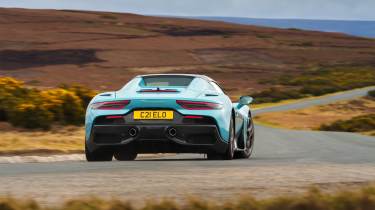
And under short bursts of acceleration you get hints of the Nettuno V6’s character, whooshes and flutters from the turbo layered on top of a bassy exhaust grumble. It develops the same 621bhp as it does in the MC20 – quite modest in a world of 800bhp+ junior Ferraris – but there’s still a sense of massive potential when you sink into the throttle. The sound is more present in the Cielo version, with its retractable hard top and drop-down rear window, which you can operate with the roof up.
Even at a calm cruise the engine brings the drama. It lacks the instant response of a modern hybrid but there’s joy to be had in feeling the onset of boost, and how the delivery comes to life in the mid-range. It’s not as musical as a 296’s V6 motor, but there are layers to the sound and those turbo noises are addictive. Left in automatic mode the shifts from the eight-speed dual clutch gearbox are smooth, and the MCPura is very pleasant to stroke along.
Corsa mode brings a fierce edge to the powertrain, the exhaust becoming more vocal and the throttle being more reactive (although not enough to mask the turbo lag.) The MCPura feels rabidly fast when fully on song, and in some ways the need to keep it on boost adds another dimension, forcing you to commit to the throttle and keep the engine lit to deliver its maximum. You need to get on the power earlier than normal for the power to hit exactly when you want it, but anticipating this – and the inevitable squirm at the rear – is a thrill in itself.
In Corsa the gearshifts are sharper and punch home with a thump – this adds yet more drama but the changes in GT are more seamless and don't upset the car as much.
Driver’s note
‘The engine has a wild nature, and its delivery is worlds apart from the controlled, almost lag-free surge of, say, a hybrid Porsche 911 GTS. Low-end response is a little soft but the way it bursts into life as the turbos wake up to deliver the full 621bhp is frantic and addictive.’ – Yousuf Ashraf, evo Senior Staff Writer
Ride and handling
- Calm cruising ability in GT mode, with a real edge in Corsa
- Damping doesn’t have the sophistication of a Ferrari or McLaren
- Exploitable and playful beneath its initially intimidating character
Towns and motorways aren’t where you can explore the MCPura’s full potential, but they do demonstrate its bandwidth. In pretty much any environment it’s calm, undemanding and deeply special to be in. In GT mode the steering is light, the damping is supple and it doesn’t feel especially wide, because you can place it with easy precision. Its wild side doesn’t come to the fore, and you can easily settle into it on a long drive.
Start upping the pace, however, and some cracks start to appear. Primarily in the damping, which struggles to control the body at higher speeds, causing the underside to brush the tarmac through big compressions. Perhaps a side effect of the MCPura being quite heavy – the claimed weight is 1475kg or 1560kg for the Cielo, but we’ve previously weighed an MC20 coupe at 1700kg, and that’s despite it having a carbon chassis. It’s worth switching to Sport or Corsa and stiffening the adaptive dampers to their middle setting (or even the firmest) to keep the MCPura dialled into the road, and dealing with the more jittery and reactive ride quality this brings.
None of the modes are an ideal compromise and as a result the MCPura doesn’t have the effortless poise and flow of a McLaren, but it is undeniably exciting and full of life. You burst between corners under the pull of the V6 and pick precise lines, managing the flow of power to the rear as it squirms and fights for grip. On bumpy roads it can be a wild ride, but somehow in a good way.
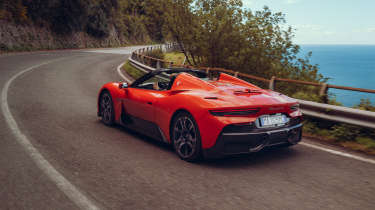
But just as your confidence and commitment grows in the MCPura, it takes a plunge when you first stand on the brakes at speed for a slow corner. Like the MC20, the brake-by-wire system lacks feel and bite at the top of its travel, which is unsettling when trying to bleed off just the right amount of speed. You don’t get the stopping power you expect until you’re deep into the pedal, which can lead you to braking further into corners than is ideal to get it slowed down. Whether it’s a limitation of the brake-by-wire system or the preferred feel for Maserati engineers, the brakes should be intuitive and reassuring in a car with so much potential, and they're not.
It’s a shame because once settled in a corner, there’s real subtlety and nuance to the MCPura. The steering is lovely, quick but not hyperactive with nicely judged weighting, and you can lean on the scrub from the front tyres, feed the throttle and precisely control the level of slip with your right foot. The explosive engine suggests this might be intimidating but it’s not, and you can use the power to get the rear moving almost imperceptibly. In this sense the MCPura actually feels more finely balanced than the more extreme GT2 Stradale on the road, which feels like it has all its grip at the rear, and is trickier to drive in that sweet neutral zone as a result.
It’s happy to be more lairy too. While the power delivery is far from linear you can excite the rear in controllable slides, at which point the MCPura almost behaves like a low-slung, mid-engined Alfa Romeo Giulia Quadrifoglio. It’s more tetchy in the wet, however, happy to spin the rears in third gear at part throttle and requiring quick hands to catch if the rear spits wide mid-corner. Again, it’s not perfect dynamically – less capable and reassuring than a Porsche 911 GTS – but the MCPura makes you think, and there’s excitement in abundance.
Driver’s note
‘The MCPura can happily lean into a GT-style role, and deliver an intense thrill when the moment comes to unleash it. It hasn’t quite stolen our hearts like the MC20 once did, but we’re glad it exists as an unapologetically pure alternative to the hybrid norm.’ – Yousuf Ashraf, evo Senior Staff Writer
Interior and technology
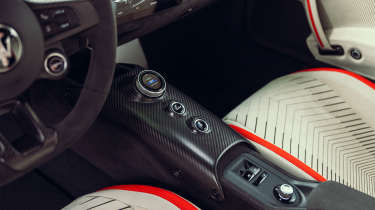
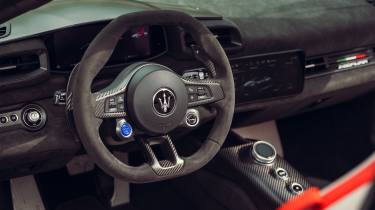
One area of the MC20 that really didn’t justify its price and halo status was the interior, and sadly that’s still the case with the MCPura. There are more alcantara surfaces in the new car and a new wheel with a flat top and bottom, but fundamental snags remain – cheap-feeling switchgear (even down to the central drive mode selector, which should be the centrepiece of the cabin) and a tacked-on infotainment screen borrowed from a Fiat 500. Oh, and the butterfly doors extend too far outwards when swinging them open in a car park, more so than, say, a McLaren’s. Which is the very definition of a first world problem.
The seats aren’t especially supportive either, but despite these niggles it’s still a special environment. The view up front is evocative with the peaks of the wheelarches in your view, and you sit lower and less upright than you do in a 911, with your legs straighter and your torso more laid back. The Cielo feels more special still with an electrochromic glass roof and, of course, the ability to fold it away completely. Buffeting is well controlled with it stowed away and you feel less exposed than you would in a conventional convertible, the Cielo’s stow-away panel being more like a targa top.
Price and rivals
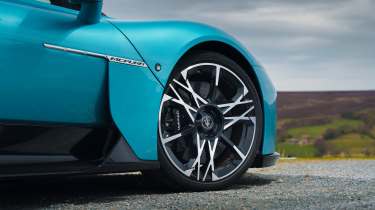
At £209,930 for the coupe, the MCPura is about on par with the McLaren Artura in terms of price, despite the latter being a more advanced, ground-up hybrid supercar. The Artura is more polished and rounded to drive – not as raw as the Maserati but more fluid, and even more satisfying. It's also available in Spider form to go up against the £234,890 MCPura Cielo.
On the more usable end of the spectrum is the latest hybrid-powered Porsche 911 Turbo S, costing from £199,100. It's a spectacularly capable car with a better finished, better equipped interior than the Maserati, but lacks the charisma and excitement of the MCPura. It's an effective everyday supercar rather than a truly thrilling one.
For a traditional front-engined sports coupe there's also the new Aston Martin Vantage S to consider, which builds on the standard car’s brutish character with more power and chassis tweaks. The Corvette Z06, meanwhile, could serve as a left-field and even more focused alternative to the MCPura, with its high-revving naturally aspirated V8 and track-tuned chassis.