Porsche 911 Targa review – the opposite of a purists 911, but still superb
Is the 911 Targa all for show? Not a bit of it. It’s better to drive than most hard-top sports cars

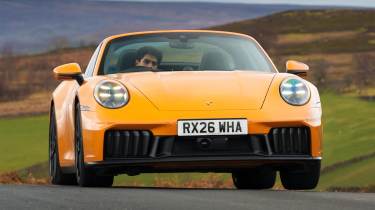
If you were to devise the ultimate Porsche 911 driver’s car, it probably wouldn’t be a hybrid, nor would it have four-wheel drive or a PDK gearbox. And it’d definitely be a coupe rather than a heavier, less rigid open-top version. That makes the car we’re testing here – the hybrid Targa 4 GTS – a purists nightmare in theory. You’d be a fool to dismiss it though, because in practice the Targa is still a fearsomely capable and well-honed sports car, and every bit a proper 911.
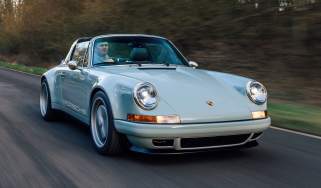
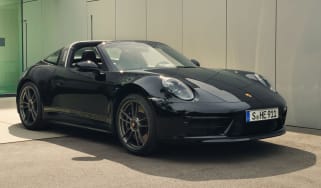
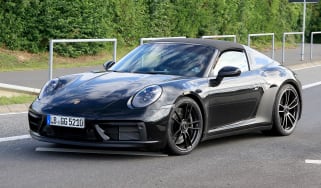
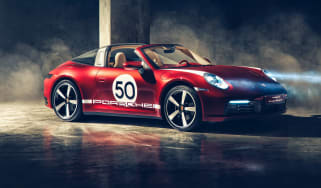
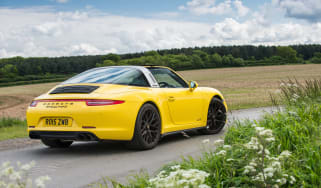
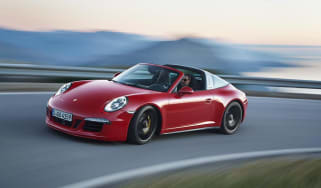
The 911 Targa dates back to 1965, and today it’s something of a unique proposition. There isn’t much besides the Mazda MX-5 RF that offers a retractable roof panel in a coupe-style body, and when you see how intricate and complex the Targa’s roof mechanism is, you start to understand why most manufacturers stick with traditional soft tops. The enormous, curved rear window raises off the body and arcs backwards, sections of the roll hoop detach to release the roof and everything seamlessly folds away and pieces back together with precision and perfect timing. It’s quite the display.
What you’re left with is a deeply desirable 911 shape, packed with muscle thanks to the 992’s wide bodyshell but much more distinctive than a regular coupe or cabriolet. For the current 992.2 generation 911, the Targa is available in two guises – the 4S and 4 GTS (as tested). Both are four-wheel drive and automatic only, with the 4S using the familiar 3-litre Carrera flat-six and the GTS having a larger hybrid unit. It’s more compromised than a coupe, certainly, and there are reasons to go for the more conventional Cabriolet instead, but the Targa is a very credible (and stylish) option – and one of the best open-top sports cars available.
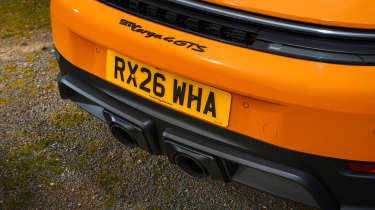
Engine, gearbox and performance
- 4S and 4 GTS both offer huge performance and traction
- Hybrid GTS engine is fantastically responsive and linear
- No option of a manual, or rear-wheel drive
More reviews
Both Targas are rapid. The 4S uses a 3-litre twin-turbo flat-six with 473bhp and 391lb ft, mated to an eight-speed PDK gearbox for a 0-62mph time of 3.5sec and 191mph top speed. The GTS, meanwhile, generates a mighty 534bhp and 420lb ft from a 3.6-litre hybrid engine, which feels part Turbo, part GT3 in how it delivers its punch. Its performance figures are firmly in supercar territory, with a 3.1sec 0-62mph time and 194mph top speed.
The GTS engine is boosted by a single turbocharger with an integrated electric motor to minimise lag. There’s a bigger e-motor integrated into the PDK gearbox, with a 1.9kWh battery pack mounted at the front. That all sounds very complicated, but the simple fact is that the Targa GTS responds and performs like a heavy-hitting, big-capacity naturally aspirated car, with enormous torque at the bottom end that blends into intense power as you wind the revs up. There isn’t much sense that electric motors are doing some of the work, until you realise that no single-turbo engine should react so sharply to the throttle. With the roof stowed you have access to a crisp flat-six howl too (some of which sounds synthesised, it must be said).
Stretching the engine with the roof down also reveals an unfortunate side effect of the Targa roof design. Something about the aperture and enormous bowl of glass catching the air behind you results in a surprisingly high amount of resonance and buffeting at motorway speeds – more than the soft-top Cabriolet with the roof down. A pop out wind deflector at the top of the windscreen improves things but doesn’t completely eradicate the issue, and it's a shame the cabin isn’t calmer when driving the Targa as intended.
Driver’s note
‘The Targa is a really impressive car, all of the usual 911 strengths shine through. As something to either drive home on a long journey or set a stage time on a closed road, it’s such a capable all rounder.’ – James Taylor, evo Deputy Editor
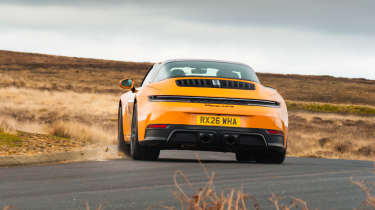
Ride and handling
- Heavier and less delicate than the coupe, but still astoundingly capable
- Four-wheel drive system offers a fantastic blend of fun and security
- Targa GTS isn’t exactly a soft, GT-like 911 – it’s still a firm and focused car
The fancy roof mechanism also makes the Targa rather heavy compared to other 911s. The 4S comes in at 1695kg, while the 4 GTS is 1745kg, making them around 100kg more than their coupe counterparts (and a little heavier than Cabriolet models).
Get moving, however, and you quickly realise the Targa is still an enjoyable and fantastically capable 911. For all its additional weight and complexity some – if not all – of the hard-top GTS’s abilities shine through, and it’s hard not to be impressed by how the Targa dissects a road. There isn’t the same clarity and precision as the coupe and it has a more heavy-set feel, but the fundamentals are sound, with a lack of shimmy through the body and a general sense of poise and accuracy. The suspension provides resolute control, too, the trade-off being a connected ride quality. Switching the dampers to Sport makes things firmer still but there’s a calmness to the body control as the speed climbs, the Targa jinking over bumps in one clean movement. It gets better the harder you drive.
There’s a definite feeling of heft when you put more load through the car, and while this does take away from the GTS’s ability to rotate hard into a corner, the weight isn’t overbearing at road speeds. Instead you concentrate on pouring through corners, setting the car up for the straights and extracting the most from that powertrain. Push harder and there’s a wide window of adjustability to play with, too, to the point where you never really wish the Targa was rear-drive instead. You can drive it on the throttle and balance it just-so from apex to exit, or be aggressive and play with bigger angles. It feels very rear-biased and can bite back, but also engages the front axle to find immense traction as the car straightens up.
Any snags? As in other GTSs, the brake feel could be more positive near the top of the pedal, with a slightly woolly initial travel and reassuring bite thereafter (which could be a by-product of the hybrid system’s regen). It can also feel wide at the hips on tight roads, and at a motorway cruise the fat rear tyres kick up too much noise in that typical 911 fashion. By and large though, this is a talented and entertaining 911 that feels more cohesive than its component makeup might suggest – even if we’d ultimately steer towards the GTS coupe for the most thrilling drive.
Driver’s note
‘Compared to other 911s I’ve driven, the GTS feels more solid and locked down in its movements. There’s less ‘give’ in the suspension – even though it’s still very stable – and it’s a little more hardcore than you’d expect of a Targa.’ – James Taylor, evo Deputy Editor
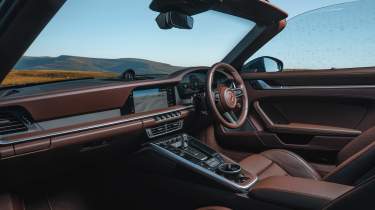
Interior and tech
The 992.2 Targa’s interior will be familiar to outgoing 992 owners, with a mix of physical controls and digital elements as well as classic 911 cues. Build quality is good, ergonomics are sensible, and the driving position is pretty much spot on. What switchgear there is (for the climate controls, for instance) is tactile and precise, and the HMI is largely intuitive. New for the 992.2 is a fully digital instrument pack, which trades the old, gorgeous analogue central rev counter for more pixels and functionality. This, and the fact the pistol grip gear selector from older 911s has been replaced by an apologetic switch, is an area where the 992 has taken a step back.
Price and rivals
You pay handsomely for the 911 Targa’s spread of abilities – the 4S comes in at £137,600, with the 4 GTS costing £154,400 – but there aren’t many directly comparable open-top sports cars. More GT-orientated options with conventional fabric roofs include the Mercedes-AMG SL55 and Maserati GranCabrio Trofeo.
The C8 Corvette Stingray, meanwhile, offers a pure sports car experience comparable to the 911’s, with a mid-mounted naturally-aspirated V8 and a manually removable hard top that can be stored in the boot. There’s also BMW’s M4 Convertible to consider, which offers similar power to the Targa GTS but can’t match its finesse and dynamic capability.
Above this there’s the likes of the Aston Martin Vantage Roadster, plus supercars such as the McLaren Artura Spider and Maserati MCPura Cielo – although these can be considered 911 Turbo rivals.