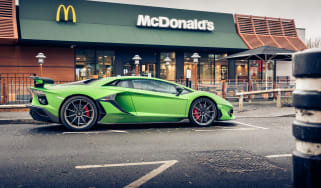
Lamborghini Aventador SVJ (2018 - 2022) review – old-school in the best possible way
Despite intimidating looks, Sant'Agata's Aventador SVJ offers one of the most exploitable experiences yet

Supercapacitors, electric motors, 2000bhp and 0-100mph in 3.2sec are figures you can’t apply to the Lamborghini Aventador SVJ. So fast is the upper-crust of supercar design moving that today, the innovations introduced on the SVJ back in 2018 don’t just pale into insignificance – they almost seem old-hat.
But like all good supercars there’s more to the SVJ than just facts and figures, and where it might exist in a vacuum of four-figure horsepower rivals, when you’re locked into its bucket seat, looking out through a true pillarbox windscreen having just pulled down the scissor door, we challenge you to feel the excitement Lambo’s Aventador always instills from the moment its V12 whirrs into life.
> Lamborghini Revuelto review – the ultimate modern supercar
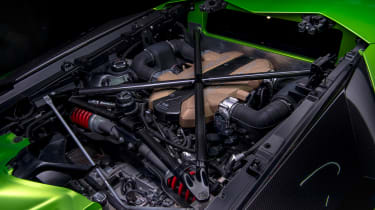
The SVJ has some fascinating engineering solutions contained within its brazenly jagged form. But even so, the heart of any Lamborghini has to be its engine and you’re unlikely to be disappointed by what lurks beneath the SVJ’s complex engine lid.
Engine, gearbox and technical highlights
The 6.5-litre motor has received another round of modifications aimed at squeezing not only more power from it, but also improving torque lower down the rev range and reducing the inertia of its internals. To that end, the V12 features titanium valves for the first time, teamed with a redesigned cylinder head, intake manifold and exhaust, the latter shorter in length and exiting higher at the rear, plus a lighter flywheel.
More reviews
Long term tests
Reviews
The stats say the SVJ makes 20bhp and 22lb ft more than the old SV, with 760bhp at 8500rpm (200rpm short of the limiter) and 531lb ft of torque at 6750rpm. While that peak torque figure is over 1000rpm higher than before, Lamborghini’s own graph suggests a healthy extra surge at both 4500 - 6500rpm over the old machine.
As you’d expect, the SVJ retains the long-serving automated single clutch gearbox, albeit with calibration changes. The 0-62mph figure is unchanged over the old SV (at 2.8sec), while 0-124mph takes 8.6sec and the top speed is ‘over 217mph’.
Performance, ride and handling
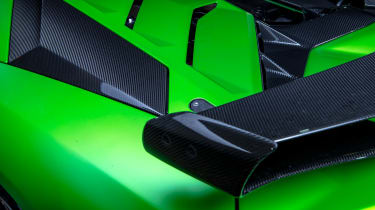
The core of the SVJ’s performance is the integration of its various systems under one umbrella (LDVA 2.0). Headlining here is ALA 2.0, a further evolved version of the active aerodynamics system first seen on the Huracan Performante. In simplistic terms, ALA features two slots in the nose of the car, with a further intake down the spine above the engine lid. With all these intakes closed the extended front splitter and large rear wing work as normal, increasing downforce by 40% compared to the old SV.
However, when the car is accelerating on a straight the front flaps open, preventing most of the air from going up and over the cockpit. This reduces the pressure on the splitter, forces air under the car (where it is carefully managed with a flat floor and a new, larger rear diffuser), and reduces drag.
At the rear, the flap opens, allowing air to rush into a Y-shaped structure that’s bifurcated, sending air into the actual structure of the rear aerofoil where it is then blasted out of tiny holes. These create vortices that disturb the air flowing over the underside of the wing, effectively ‘stalling’ it and thereby greatly reducing the drag. Clever stuff, and moreover, the left- or right-hand side of the wing can be worked independently, increasing grip on the inside rear wheel when turning into a corner.
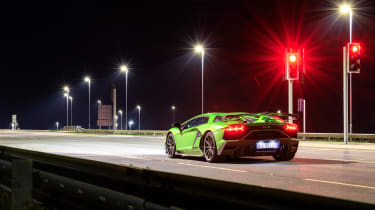
It’s at this point that the integration is critical, because ALA works with the magnetic damping, the rear-wheel steering, the dynamic steering and the four-wheel drive system to get the car in, through, and out of a corner significantly quicker than the old SV. Unlike other Aventadors, the centre clutch disengages completely under braking to give a more natural feel, while the benefits of a more agile turn in and higher grip levels (especially on the new bespoke Pirelli Trofeo R tyre, although a bespoke P Zero Corsa is standard fit) mean that the system sends torque to the front axle earlier to pull the car out of the corner.
Much of the suspension hardware in the SVJ is familiar, but it’s in the detail where the differences matter: anti-roll bars are stiffer, but spring rates are the same (as the S and SV); the dampers are recalibrated and operate over a wider bandwidth; the rear-wheel steer operates up to a smaller angle than on the S variant, and the ratio of the dynamic steering is fixed in the car’s Corsa mode. At 1,525kg ‘dry’, the SVJ weighs the same as the SV, but extensive use of carbon fibre and lighter wheels has essentially offset the weight penalty of incorporating the additional tech.
For all the talk of active aero and sophisticated electronics, there can’t be many who wouldn’t feel at least a slight pang of intimidation when the SVJ is sat in front of you – it’s impossibly low, impossibly proportioned and aggressive in a way that doesn’t just look motorsport-inspired, but exuding an extra layer of flamboyance that only Lamborghini seem to be able to carry off.
Interior and tech
Lamborghini’s senior supercars have always possessed that intimidation factor, and long may it continue: it’s an essential part of the recipe. Up goes the scissor door, and as I sink into the hard embrace of the bucket seat I’m reminded once again at how comically uncomfortable these pews are, how short the Aventador is on headroom for drivers over six foot in height, and how visibility is compromised by the girder-like A pillars. In fact, it’s now even worse, because with all the ALA ducting rearward visibility is virtually non-existent, and the side mirrors are, as ever, mainly full of chiseled flank. The Aventador remains, in the truest sense, a proper supercar.
Nevertheless, some things are clear. The motor is an absolute force of nature: it does pull with a little more conviction from the mid-range, but it’s still all about the lunge for the redline, something it does with frenzied enthusiasm. Hook the sturdy right-hand paddle for the next gear and it thumps home without much grace, but the engine revs drop straight back into the meat of the powerband and the process begins again unabated. The engine noise at 8500rpm from within the cabin is all consuming, and from the outside it’s utterly spectacular.
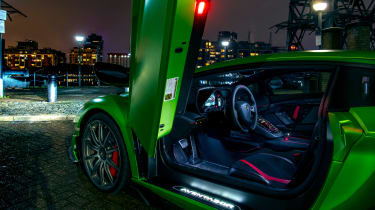
Brake hard from high speed and you can feel the weight of the V12 behind you, the car yawing gently, suddenly alive and on its tip toes. The giant ceramic brakes have a softer pedal feel than, say, one of McLaren’s more aggressive offerings, but there’s good modulation on offer and no questions over their outright stopping ability.
From the moment you turn the wheel into the corner the SVJ feels surprisingly agile, and it’s worth taking a moment to finesse your inputs at this point because driving the SVJ only requires small inputs most of the time. Traction out of the corners is equally impressive, but it’s the balance of the car that really makes it so enjoyable. If you’ve gone in too hot into a corner a small lift of the throttle has a surprisingly large influence on the trajectory of the car, without it feeling nervous.
There’s rarely a feeling of the engine’s weight threatening to overtake the front – in slow and medium speed corners, at least. Near its limits it’s surely still a car that demands the utmost of respect, but there’s always the invisible safety net of the ESP system to rely on. Indeed, so deft is its operation that the ‘Ring lap time was recorded with some of its assistance left in place.
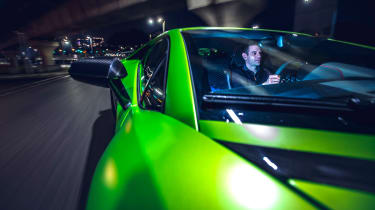
Yet the most encapsulating thing about the SVJ is that even on road, beyond these incredibly high limits there’s an approachable nature to the chassis and the balance keyed into it despite the locomotive-sized powertrain only inches away from the driver’s seat. It’s not so much a job to get the nose locked in – the steering is so sharp, precise and fast that it’s purchase is always dependable – but start augmenting the rear with the V12 and it’ll instantly neutralise, giving you options into and out of the corner. That the engine is also so acutely responsive helps with the intimidation factor, but over rotate the rears and the rear will swing subtly and swiftly at lower speeds and the SVJ could almost be called playful. Without an inherent sense of momentum to worry about, these low speed antics make it all the more tempting to take liberties, again, and again, and again.
Living with the Lamborghini Aventador SVJ
Supercars and snow don’t mix. At least not in the UK, where our perennial unpreparedness for proper winter weather inevitably sees us skating around on summer tyres for those few isolated days when we get a flurry of the white stuff. Chaos ensues, of course, but there’s something typically British about battling against the elements with inappropriate equipment.
It’s this Shackleton spirit that saw me heading out on the most middle class of missions – driving to Waitrose for essential food supplies – in a Lamborghini Aventador SVJ, just as snow began to settle on the roads of rural Northamptonshire. Naturally the Lambo was running on Pirelli P Zero Corsas, the sticky compounds from which they are made having gone into hibernation back in November. Had I considered that the inch or so of snow that had already settled as I set off would grow to four or five times that depth by the time I would be heading home I… still wouldn’t have taken Mrs M’s all-season shod Freelander 2, as where’s the fun in that?
Suffice to say I got some slightly odd looks from my fellow shoppers as I trudged out through the car park, they loading the boots of their Range Rovers and Audis while I pushed my trolley towards the Italian-registered Lambo, popped the scissor door and loaded my bags into the passenger footwell and onto the seat. An intrepid Z3 M Coupé owner stopped for a chat (evo reader, natch), both of us acknowledging the silliness of our respective means of transport and pondering that the drive home might be more of a challenge than we thought.
You won’t be surprised to learn that Aventadors are not the best machines for discreet, rapid getaways. When you have to wait with the cold engine bellowing away on fast idle while several hectares of windscreen slowly demist, it’s actually slightly embarrassing, though the disapproving looks from appalled quinoa warriors lifted my spirits.
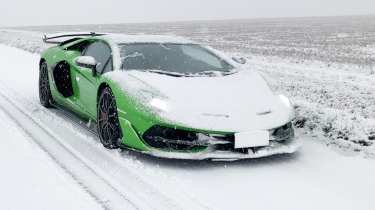
Off the main roads no gritting had been done by the council (too skint having spent all its money on cycle lanes, presumably), so the road and verges were almost merging into one white blanket, but the Aventador managed to find plenty of traction, even on long inclines. It steered well, too, so although the pace was circumspect, it was a lot of fun to slither this ridiculous 700bhp wedge along the deserted lanes.
Braking was less enjoyable, especially when heading downhill on compacted snow, the dread sensation of a pulsing pedal, the zizz-zizz-zizz of the ABS and very little in the way of useful retardation causing a spike of adrenaline and a few muttered profanities. Nevertheless I made it back home without incident – only to have to head back out to take the SVJ to John Barker’s house and swap into the Fast Fleet Supra. The decidedly dicey homeward journey proved just how well the Lambo performed, and how daft it is to drive a two-wheel-drive car in proper snow on summer tyres. Will we ever learn? I doubt it. – Richard Meaden, evo issue 284
Price and specs
Each of the 900 SVJs produced were priced from £360,000 when they were on sale between 2018 and 2022, with our left-hand drive Fast Fleet SVJ coming in at closer to £420,000 thanks to an expensive combination of exposed carbonfibre and matt green paint. Despite the price, it still lacked the ability to plug your phone into the 20 year-old Audi nav system, not to mention an inability to get any radio signal either. None of us cared.
Lamborghini Aventador SVJ specs
| Engine | 6.5-litre naturally aspirated V12 |
| Power | 759bhp |
| Torque | 531lb ft |
| Weight | 1525kg (dry) |
| 0-62mph | 2.8sec |
| Top speed | 217mph |
| Price new | £360,000 |
| Value today (2025) | £450-600k |