
Ferrari Roma (2020 - 2026) review – the entry-level Ferrari better than an SF90
The Roma set itself apart as a truly compelling entry point to Ferrari ownership, and one our favourite modern GTs
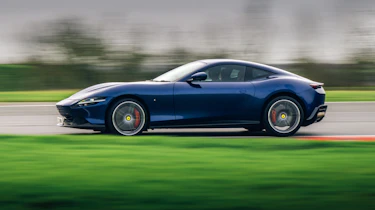
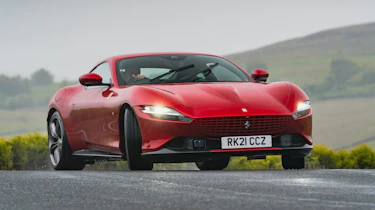
The reveal of the Roma was quite different to the usual Ferrari affair, but then the Roma was a different sort of Ferrari. After increasingly ‘technical’ looking cars with forms that followed function, the Roma reversed the strategy, all the way back to the ’60s, with a shape that owed more to the designer’s pen than the wind tunnel.
Six years on from its launch, the Roma still looks good, though it’s perhaps a rarer sight than Ferrari had hoped. Mind, it was the company’s first-ever front-engined V8 coupe and followed in the wheel tracks of the outstanding V12-engined 550 Maranello.
It took over directly from the Ferrari Portofino and the earlier California, which always felt like the entry-level car Maranello needed to make to bring in a new audience, rather than something designed and developed with the love and attention of a proper Ferrari. It wasn’t until the Roma that the entry-level Ferrari truly blossomed. Despite sharing core components with the Portofino, the Roma was an altogether more impressive car when it launched in 2020 – a truly desirable GT in its own right.
The Roma has been replaced by the Amalfi including in Spider form, but it’s no surprise that the new car is very much an evolution of the theme rather than a radical reinvention. Six years on from launch the Roma is still a brilliant, authentic Ferrari. That used examples can now be had for £130k – the same as a 911 Carrera S with a couple of options – makes it even more compelling.
Engine, gearbox and performance
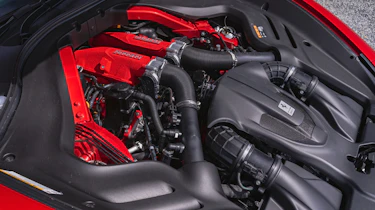
- Twin-turbo flat-plane V8 with 611bhp
- 70 per cent new componentry over the Portofino
- Fantastic engine performance and response, if not the most stirring soundtrack
More reviews
The engine, although similar on paper to the Portofino’s, is more responsive and engaging. Sure, a flat-plane-crank twin-turbo V8 is never going to charm like a big-capacity V12, or even traditional V8s as fitted to rivals like the Aston Martin Vantage and Mercedes-AMG GT, but it’s willing, rev-hungry and makes the Roma fly.
Give the throttle a decent squeeze and the Roma picks up crisply and drives forward with all the thrilling eagerness you expect from a 600bhp+, twin-turbo V8. Stretch the engine and the pace never seems to let up, the rev-counter needle swinging to 7500rpm and the eight-speed DCT slipping instantly into the next ratio so that the acceleration is seamless and relentless – something that couldn’t be said of the Portofino.
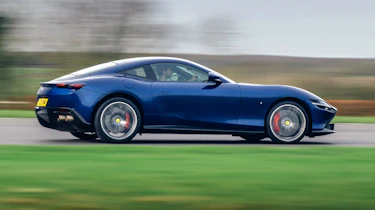
The Roma has about 20bhp more, weighs about 100kg less (on our scales, 1650kg) and has shorter gearbox ratios, but it feels much more than the sum of those parts. It makes 611bhp at 7500rpm with torque unchanged at 560lb ft, the uplift coming through increased valve lift and the closer monitoring of turbocharger speeds, enabling better matching of the cylinder bank outputs and allowing the turbos to rev 5000rpm higher.

There’s bandwidth to the powertrain too, the gearbox being happy to slur away in automatic mode or fire through manual changes brutally fast and hard. Use it to keep the engine within its 2250rpm-wide torque sweet spot above 3000rpm and the experience is unforgettable.
In today’s age of hybrid assistance it’s a setup that has taken on a certain old-school charm, even with the Roma’s eight-speed dual clutch transmission and the full roster of electronic driver aids working to best utilise the engine’s output. Some brands get paddle shifters almost comically wrong given how often drivers interact with them but the Roma’s elongated metal (or optionally, carbon) items are beautifully tactile, within natural reach and operate with a satisfying mechanical feel.
Being a flat-plane-crank V8, the sound is rather two-dimensional compared with the surround-sound thunder from the crossplane crank V8s of an Aston Martin Vantage or Mercedes-AMG GT. There are no silencers in the Roma’s exhaust, sound absorption being handled by the GPFs (gas particulate filters) and the reduced-size catalysts upstream of them, leaving the NVH engineers to play with pipe lengths and diameters to tune the sound. It’s purposeful and similar in tone to the F8 Tributo. There’s an oval bypass valve whose opening is automatic and load and throttle position sensitive.
The Comfort setting on the Manettino has been configured to reduce emissions and the responses of the powertrain are dialled back further as a result - the gearbox less eager to downshift in auto mode and a discernible lag when you ask for power through the throttle. The Sport setting completely eliminates any hesitancy, even when the Roma is shifting for itself. In raw numbers both the coupe and Spider deliver the same 3.4sec 0-62mph time. Top speed is rated at 199mph in both as well.
Driver’s note
‘There’s a muscular tautness to the way the Roma drives, the steering keen and direct, while even at a canter the shifts of the eight-speed DCT gearbox are smooth and snappy. Slightly at odds with this is the ride, which starts in Comfort mode and really does deliver what it says, the Roma moving with a plushness that’s pure GT.’ – John Barker, evo Editor-at-Large
Ride and handling
- Chassis electronics include Side Slip Control, five-stage Manettino switch and an electronic differential
- Light, quick steering takes some time to build confidence with
- Fantastic blend of sports car sharpness and GT comfort
The Roma was based on the Portofino (née California) platform, which on the face of it wasn’t the most promising starting point, but Ferrari was quick to point out that 70 per cent of the Roma chassis was new and that it was a GT with a sporting edge, fitted with Side Slip Control 6.0, an E-Diff, Ferrari Dynamic Enhancer and a Race mode, to be called up via the famous manettino switch.

Its stance is quite different to that of the Portofino, being 70mm longer, 36mm wider and 17mm lower, and featuring wider wheel tracks front and rear. Dropping down into the low-slung driver’s seat, it feels like a very different car too. You get the first clue that dynamically the Ferrari Roma is going to be a bit special within yards. On bumpy roads all that comes through the structure is a soft, quiet pattering. Even in the roofless Spider, over imperfections and motorway expansion joints the Roma has the comfort and relaxing feel of a proper GT.
Initially the steering can feel too light and ultra reactive, particularly in the wet where more measured responses and weight build up would inspire more confidence. The Roma feels naturally agile, keen to the steering. It uses the same physical steering components as the Portofino but the structure of the Roma is stiffer, while the mounting of its rear axle is more positive, which means there’s no slack to take up; you turn the wheel and the whole car turns.
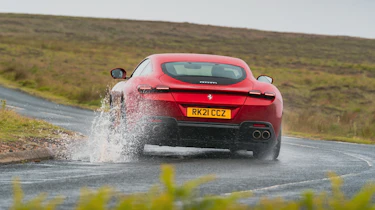
Get on the power early mid-corner and traction control quietly asserts itself, unleashing the engine’s torque only once the car is pretty much straight and the traction is undefeatable. Even with all aids off, the Roma has impressive traction thanks to the E-Diff. Drive it to the limit of front grip – if you dare – and you’ll be flying, occasionally leaning heavily on the powerful (and standard) carbon-ceramic brakes with their fine feel.
Flick the Manettino to ESC Off and you appreciate just how much grip there is and how hard the E-Diff works to maintain traction. Even once you’ve turned in sharply to a hairpin, it takes a proper slug of throttle to unstick the rear. Once it’s out there, the Roma feels comfortable with a twist of opposite lock and comes back into line reasonably neatly, and it’s much the same in the wet, the rear axle finding a surprising amount of grip and traction.
As promised, the Roma is very much not a Portofino coupe. Imagine the F8 Tributo re-formed as a front-engine, rear-drive coupe and you’re pretty much on the money. It’s sharp, responsive, and biddable. Yet while it’s as dynamic and fast and sporty as you want, it also delivers the grand tourer bit of the brief as well. Refinement is good; the seats are still comfortable after many hours at the wheel.
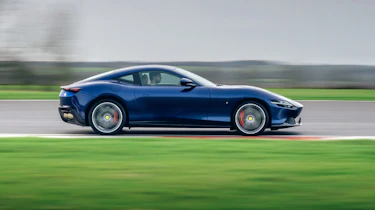
Ferrari absolutely nailed the ride, too, which is exceptionally supple yet tightly controlled and quiet, though tyre choice is important. A Pirelli P Zero was specially developed for the Roma, but a car maker always ensures there’s at least one alternative and in this instance it’s the Michelin Pilot Sport 4 S, which offers similar steering quality and grip but a noticeably firmer ride, probably because it has been carried over from the Portofino. In our experience, there was no need to use the ‘bumpy road’ button at all on the Pirelli but it got a lot of use on the Michelin.
The further you drive the Ferrari Roma, the more impressive it is as a sports GT. Refinement is good, the seats are still comfortable after many hours at the wheel. The coupe’s 1570kg kerb weight gives a 395bhp/ton power to weight ratio, and the Spider version is only 84kg heavier. The increase is thanks to the roof, plus stiffening along the sills, in the A-pillars and beneath the boot floor but the strength of the engine renders the difference almost imperceptible.
Driver’s note
'As with all contemporary Ferraris, what’s most impressive about the Roma is its fidelity. Such is the exactness of its chassis and powertrain integration it always feels in harmony with itself. And thanks to the genius of the manettino settings, you can pretty much guarantee it will also find harmony with the road. It’s an impressive and seductive blend of fine Ferrari GT tradition and 21st century technology.' – Richard Meaden, evo editor-at-large
MPG and running costs
The Roma’s relatively subdued Comfort mode certainly did the trick on the official WLTP efficiency tests. Both coupe and Spider return in the region of 25mpg on the combined cycle with CO2 emissions of 255g/km and 258g/km respectively. Actually achieving those kinds of numbers in the real world would require formidable restraint but the 80-litre fuel tank means it’s perfectly possible to extract a touring range befitting of a continent-shrinking GT car.
Testing the Spider gave us an indicated range of just over 300 miles on a full tank and economy of around 18mpg after 150 miles, predominantly on the motorway. No surprises that efficiency goes south very quickly when the Roma stretches its legs and the car’s range metre does its best to reflect this, revising its estimates rapidly, and sometimes disconcertingly, according to the driving conditions. It’s better seen as a cautionary tale of how far you’ll get if you keep driving like that.
Interior and technology
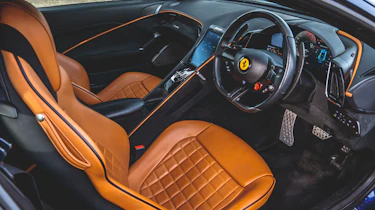
The Ferrari Roma’s boot isn’t huge for a GT, being reasonably long and wide but rather low, though the backrests of the teeny rear seats fold down, Porsche 911 style, in the hard-top car. If you’re interested, there’s 272 litres of capacity that expands to 345 litres with the back seat lowered.
In the Roma Spider convertible the boot is compromised further by the stowage area for the folding roof, but there’s still space for a couple of soft bags with the roof down. Capacity with the roof up is 255 litres, only 17-litres down on the coupe.
The divider between the luggage area and the cab that forms the rear seat backs can be flipped-up to form a wind deflector but even without this the low seating provides decent shelter - especially with the windows raised. Operating the roof takes 13 seconds in total and the opening or closing procedure can be performed at speeds of up to 40mph.
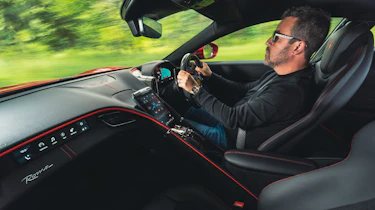
From behind the wheel the Portofino is an oddly roomy car, but dropping into the Ferrari Roma is like lowering yourself into the bath, the individual driver and passenger cockpit areas giving a close, low, intimate feel – one wound back somewhat in the more open set-up of the new Amalfi’s cabin. The rear seat behind the front passenger is usable by children or possibly small adults - assuming a compromise on legroom can be negotiated. A small child might also be able to get behind a very small driver at a squeeze but most owners will sensibly use the +2 seating as extra luggage space.
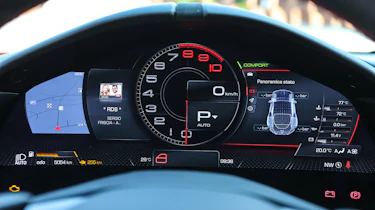
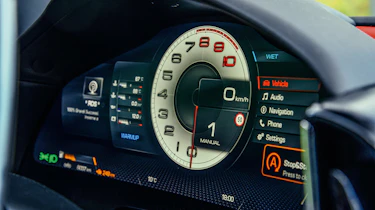
The most contentious part of the Roma is its switchgear. Largely this is shared with the SF90 hybrid supercar and includes a wide, TFT screen with a central tacho and different screens either side, and many touch-sensitive switch pads, some of which revert to black when not in use. The Roma also gets a tablet-like central touchscreen wedged into the cleavage of the dashboard.
If you want to be able to find things, or change screens, or simply adjust the temperature or audio volume once you’re driving it’s best to spend a few minutes working out how to do this before you get going. Even then, certain functions may elude you – the central locking button, for instance. It’s roof-mounted (yes, really) and touch-sensitive, and while there’s a loud confirmation click for certain button pushes elsewhere, there isn’t one for unlocking the doors, so you don’t know if you have. And while we’re on the doors, there’s no internal latch; instead you press a button on the door pull…
Ferrari designs its cabins so that the car’s key controls are accessible without removing your hands from the wheel, but it necessitates a Swiss army knife of a steering wheel with all manner of knobs, buttons and rotary controllers - some of which work better than others. Perhaps the Roma’s greatest crime is that the start-stop button is a lifeless touch sensitive panel under the central bulge of the steering wheel – something it’s now remedied with the Amalfi’s anodised physical starter button.
The Amalfi has certainly lost something in terms of design drama compared to the Roma. The older car’s dramatic, cocooned cabin design has been replaced by something more open and conventional.
Price and rivals
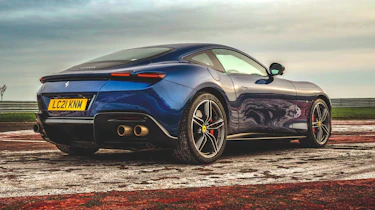
Initially the Roma was priced at around £170k, a figure that would quickly rise with a delve into the extremely long and expensive options list. The Roma Spider convertible, on the other hand, came in at around £210k. These days you’ll need to stump up £130k for a tidy used coupe, with the cheapest (and inherently newer) Spiders coming in at £130k.
The Roma coupe was first delivered to customers in 2020 but when the Roma Spider arrived in 2023, Ferrari stopped taking orders for the hard-top car. The Amalfi and imminent Amalfi Spider replaces them both.
The Roma’s rivals included the Aston Martin DB11, and later in its life the DB12 and Vantage, the latter of which received a boost in power and aggression to meet the Ferrari head on. On the more luxurious, GT-oriented end of the scale is Bentley’s Continental GT and the Maserati GranTurismo. Neither get close to the Roma in terms of outright sharpness and performance, but there’s much to be said for their more comfort-led approaches and more practical interiors.
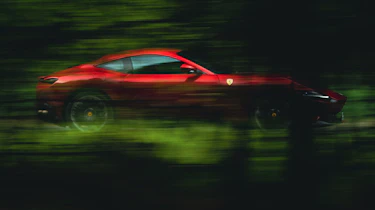
Customers tend not to configure their cars in bright colours as the UK press office does. Even the earliest cars have covered modest miles, typically less than 25,000 miles, and prices start at about £130k. Note that Apple CarPlay was a £2400 option.
It’s electrical gremlins that are the cause of most complaints, mostly related to the battery, so many owners keep them on a quality trickle-charger. Other owners suggest that a dab of the start button to wake the car and then allowing all the screens to come to life before hitting and holding the start button helps avoid glitches. Mechanically, the Roma is solid.
Peace of mind is available at a cost. From new, UK cars come with a four-year warranty and seven years’ servicing. You can now buy a warranty to cover years 4-8, at £5060 per year (£7920 for two years), and beyond that up to 16 years at £4680 per year including servicing (£3600 without). Ferrari backs the cover, not a third-party insurer, and cars bought outside the dealer network are eligible once inspected and any required work has been carried out by the dealer.
Ferrari Roma specs
| Engine | 3855cc, twin-turbo |
|---|---|
| Power | 611bhp @ 5750-7000rpm |
| Torque | 560lb ft @ 3000-5750rpm |
| Weight | 1570kg (395bhp/ton) |
| 0-62mph | 3.4sec |
| Top speed | 199mph+ |
