Ford Focus RS500 (Mk2, 2010 - 2011) review: the original hyperhatch
The Ford Focus RS500 is the ultimate incarnation of a hyperhatch trailblazer, and now they're like gold dust
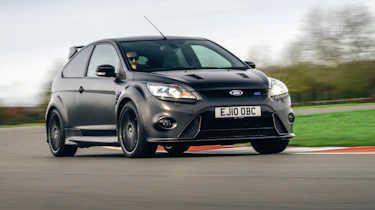
Only one modern hot hatchback howls to the tune of five cylinders today, the Audi RS3. These days the Audi is far more than just a great engine strapped to a so-so chassis, but it still doesn’t hold the title of our favourite five-pot hatch. That accolade goes to the second-generation Ford Focus RS launched in 2009, with a highly tuned five-cylinder powering the front wheels alone.
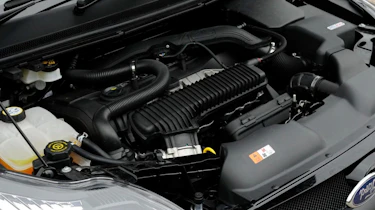
Listen closely and Ford’s ‘five’ spoke with a Swedish accent, since the engine used by both the RS and the Mk2 Focus ST was based on a 2.5-litre Volvo-derived unit. But Ford put its own work into the RS engine, with stronger connecting rods, new pistons, new camshafts, and a larger Borg-Warner turbo fed through a bigger intercooler and redesigned intake. No Volvo of the time matched the RS’s 300bhp or 324lb ft, and no prancing moose handled like the RS did either. Ford’s engineers pulled a blinder in harnessing one of the brawniest outputs we’d yet seen from a hot hatchback.
> Used Ford Focus RS (Mk1, 2002-2003) review – redemption for Ford's ultimate modern classic?
There was some clever work at play to ensure the RS didn’t simply turn its front tyres into two steaming black stripes on the asphalt or have you straining each arm to prevent it torque-steering between the hedges. There was a Quaife limited-slip differential for a start – a development of that in the previous RS, with friendlier lock-up characteristics to mitigate the old car’s verge-hunting – but significant too was the use of what Ford called RevoKnuckle front suspension.
More reviews
This was Ford’s version of a system we’re now quite familiar with, a MacPherson strut where the steering axis is separated from the movement of the spring and damper, making the steering less susceptible to changes in suspension geometry. The tech is known by numerous names – Toyota calls it Super Strut, RS Méganes used a PerfoHub, General Motors has Hi‑Per Strut, and it’s known as ‘dual-axis’ on the Civic Type R – but it worked just as effectively in the Mk2 Focus RS, which wasn’t just faster but also easier to drive than its occasionally unruly Mk1 predecessor.
It was right up there with the best of its era, in fact, that being the Mégane R26.R. The Mégane only narrowly took the win when Henry Catchpole brought the pair together on the Col de Vence back in 2009 (evo 129), writing of the Focus: ‘When the wave of forced-induction torque ramps up, it reminds you of everything that is great about turbocharged engines – that wonderful feeling that your right foot has unleashed a slightly uncontrollable storm and suddenly the car is running away from you a little.’ He added: ‘Not once in the hour-long drive back did I think “I wish I was in the Mégane”. Nor did I wish that I had four-wheel drive.’
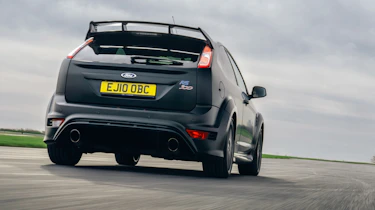
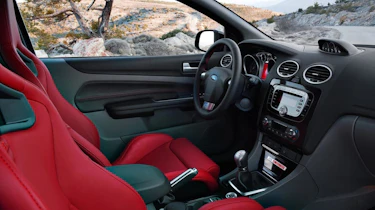
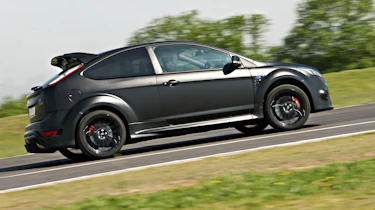
The Focus, then, challenged our preconceptions: of how much power you could send through the front wheels, and of how finely crafted a driver’s car you could wrap in such brutal, eye-catching styling. It was certainly attention-grabbing (possibly a little too much, for some), even if you didn’t specify some of the louder colours. The same went for the cabin, which was pleasingly chunky and well-built by previous Ford standards but had enough touches to mark it out as something special too, with colour-coded panels in the Recaro seats, a starter button near the gearlever, and a dash-top gauge-pod nicked from its less extreme ST sibling.
Then in 2010 Ford brought back a fabled name from its back catalogue when it launched the matt-black Focus RS500. While not a homologation special like the Group A-dominating Sierra RS500, you still wouldn’t have wanted to bump into one in a dark alley. Upgrades to the intercooler, induction system and downpipe, plus a high-flow fuel pump and a retuned ECU saw outputs swell to 345bhp and 339lb ft, putting it among the most potent front-wheel-drive cars of all time, with 20bhp more than today’s FL5 Civic Type R. Ford didn’t fiddle with the chassis, but it didn’t really need to. Understandably, it could be a handful in the wet, but as we wrote in 2010, ‘As long as it’s dry the Focus is devastating. No hot hatch is as much of a blast to drive, and in the final analysis, that’s what matters.’
The RS’s appeal hasn’t waned today, something that becomes obvious when scouting the classifieds for a used one. While a five-cylinder Focus ST can be yours from around three grand, you’re looking at a starting point of around £20,000 for all but the scruffiest RS – about the same as you’d expect to pay for an early four-wheel-drive Mk3 RS, and a little more than the cheapest Mk1s. Dealers are asking as much as £35,000 for the very best, unmodified and low-mileage cars, and while this sounds like a fair chunk for a late-2000s hot hatch, it’s still seven grand less than a brand new Golf GTI. As for the RS500, you're looking at around £70,000 for an example with reasonable mileage...
Ford folks just love the styling and that five-cylinder engine, not least because both respond well to aftermarket tweaking, and the only thing better than a fast Ford is an even faster one. This does bring extra risk to the buying process, as aftermarket remaps and eBay suspension kits abound. There’s a time and a place for modification, but there’s not much we’d change about the base car, so we’d focus our attention on finding something relatively untouched. The good news is these are pretty robust cars to begin with, less prone to corrosion than their predecessors (though not immune), and generally well-built. The 3M wrap of RS500s didn’t age well, so most of those will have had replacement wraps at some point, while wear and tear can take its toll on suspension bushes. Tyres are obviously put under a lot of strain (budget £140 a corner for Michelin PS5s, plus fitting), as is the clutch, though the gearbox and Quaife diff are pretty resilient.
As for that engine, Volvo, and subsequently Ford, did a sterling job. It’s proven capable of withstanding the sort of power outputs the aftermarket has thrown at it, but left alone and simply serviced on schedule it’ll happily carry on making five-cylinder noises for hundreds of thousands of miles. Specialists recommend more regular servicing than the specified intervals – Ford’s 125,000-mile/10-year timing belt service is a little optimistic – and oil and radiator leaks aren’t uncommon, but kept lubricated and watered, there’s not much to worry about.
Not as ultimately capable as its all-wheel-drive successor, but more visually distinctive and more fluid, the second-gen Focus RS is undoubtedly one of Ford’s greats – one that can still show a few modern hatches a thing or two for pure enjoyment. And not one of them, other than perhaps that Audi RS3, can match the RS’s five-cylinder engine for character.
What to pay
Limited to 500 cars worldwide, a mere 101 RS500s were allocated to the UK, and every one was snapped up within a week. At the time of writing in April 2026 there are a mere 9 actively registered, while almost 80 are SORNed, which says a lot about where owners feel values are going. The RS500 cost £35,750 in 2010, but 16 years on you won’t find one for much less than £70,000. That’s more than double the price of a standard Mk2 RS with modest miles, but limited supply means values of the special edition are holding strong.
What to look out for
If you do take the plunge, the RS500 is a largely reliable machine. Its engine and transmission have both proven to be very strong even when dealing with more power than Ford intended. That said, beware of an uneven idle, which may take some trial and error to resolve (spark plug, coil or mass air-flow sensor failure are among the possible causes). Also check closely for rusty bodywork, which has affected some Mk2 RSs. But beyond these issues, an RS500 should be a very reliable and useable hot hatch – and one that deserves to be driven.
What we said
'At low engine speeds the added power is largely undetectable, although the exhaust seems to burp even more readily when you lift off. But once the rev needle swings past 3500rpm you’re aware of extra pressure in your back, the engine feeling even more frantic in the way it piles on revs. There’s also a tad more volume from the exhaust and a greater repertoire of pops, bangs and whooshes. It’s highly entertaining and downright rapid.
As long as it’s dry the Focus is devastating. Yes, the wheel does tug, but it’s manageable (unless you’re in second and deliberately thuggish with the throttle), the diff doing a great job of getting the lion’s share of the 339lb ft to the floor. But in the wet the same isn’t true and the RS500 will happily, readily break traction in third. However, work at it and learn it and the Focus is able to make enormously rapid progress.
It’s never dull, not for a second, but neither is it particularly polished and it remains a hard car to drive smoothly. But for all that no hot hatch is as much of a blast to drive, and in the final analysis, that’s what matters.' – Ollie Marriage, 2010
Ford Focus RS500 specs
| Engine | In-line 5-cyl, 2522cc, turbocharged |
| Power | 345bhp @ 6000rpm |
| Torque | 339lb ft @ 2500-4500rpm |
| Weight | 1467kg |
| Power-to-weight | 239bhp/ton |
| 0-62mph | 5.6sec |
| Top speed | 165mph |
| Price new | £35,750 (2010-11) |
| Value today | From c£70,000 |