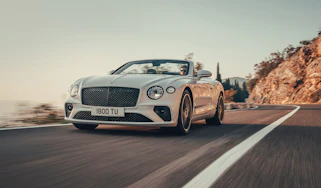
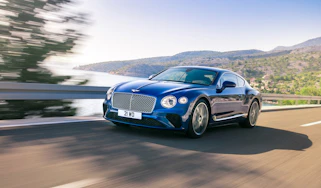
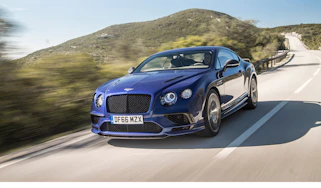
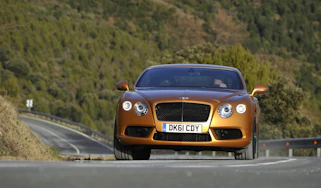
Bentley Continental GT review – not Ferrari sharp, but still the ultimate grand tourer
The fourth generation Continental GT marks a step change, packing hybrid power for the first time. The result is one of the most accomplished grand tourers you can buy
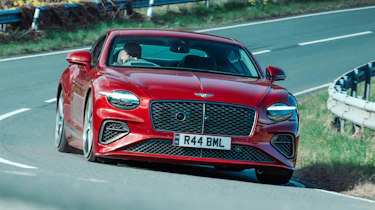
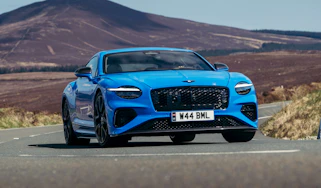
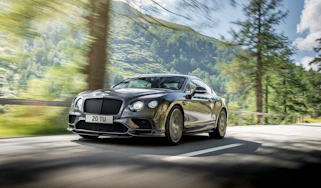
Bentley took a different approach when it launched the fourth generation of the Continental GT, the car that re-established the brand a quarter of a century ago and has been a mainstay of the company ever since. Rather than start with the ‘entry level’ GT (seems wrong to call a Bentley ‘entry level’), the latest Conti launched as a range-topping Speed model. As a car to showcase what Bentley’s new flagship coupe (in effect an updated version of the previous model) could do, it was very convincing – a 771bhp V8 powerhouse with the plushness you’d expect of a Bentley, with some unexpected athleticism thrown in. And, crucially, hybrid power for the first time, future proofing the model against ever tightening emissions regulations.

The Speed was proof that electrifying the Continental has diluted none of its appeal, and now the range has expanded to include cheaper models – the GT and GT Azure – as well as a more driver focused GT S, and even more luxurious GT Mulliner. Meanwhile the arrival of a new, rear-drive, bewinged GT Supersports means there’s now a flavour of Continental for pretty much anyone.
Even so, it certainly doesn't have the market to itself. There are many other flavours of GT to choose from in 2026, from Aston Martin’s impressive new DB12 S to the Ferrari Amalfi and the newly updated Maserati GranTurismo. These are cars with more sporting intent than the Bentley and in most cases higher rewards, but there’s still plenty to be said for the Continental’s more considered and luxurious approach. In many ways it’s the definitive grand tourer.
Engine, gearbox and performance
- Hybrid 4-litre V8 improves efficiency without sacrificing character
- Four-wheel drive system with e-diff offers supreme traction
- Base GT is more than quick enough; Speed is ballistic
More reviews
Group tests
In-depth reviews
Reviews
- New Bentley Supersports review – 500kg lighter Continental GT is the best yet
- New Bentley Continental GT S review – the sweetest Continental aimed at Aston Martin's DB12
- Bentley Continental GT Speed 2025 review – driving the most powerful Bentley yet
- Bentley Continental GTC Speed 2025 review – huge power, huge weight, huge price
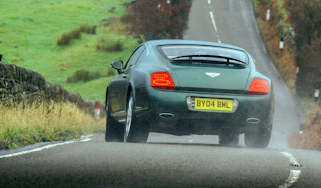
- Bentley Continental GT W12 (Mk1, 2003-2010): the car that saved Bentley
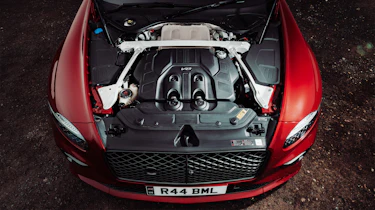
With 771bhp and 738lb ft from a combination of 4-litre twin-turbocharged V8 engine and 140kW electric motor, the Speed (and the GT Mulliner, which uses the same running gear) has most of its rivals licked when it comes to outright power. The electric motor is integrated into an eight-speed dual-clutch gearbox and fed by a 25.9kWh battery pack.
Not only does the hybrid system afford 50 miles of electric range at up to 87mph, it supports the V8 to give the Speed fantastic low end response and huge performance. 0-60mph comes up in 3.1 seconds and it runs to a 208mph top speed, and the way it delivers these numbers is completely fitting of a Bentley. There’s no drama, just a sense of effortless muscle as you work through the revs, with a satisfying V8 grumble from the exhaust. Traction from the variable four-wheel drive system is near unbreakable unless you’re very heavy handed out of a corner, too, meaning all the power is accessible at pretty much all times.
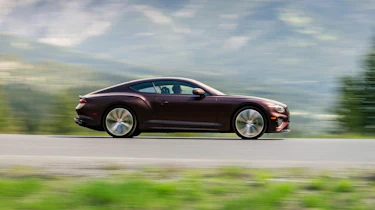
Despite having the same essential underpinnings as the Speed, lesser Continentals – the GT, GT Azure and GT S – get what Bentley calls a ‘High Performance Hybrid’ powertrain to differentiate it from the Speed’s ‘Ultra Performance Hybrid’ system. In reality this means it’s been detuned by 100bhp to 671bhp, with peak torque of ‘only’ 686lb ft, although there is still the small matter of a 2384kg to push around. But push it around it does.
You really don’t miss the extra muscle of the flagship, partly because the Continental isn’t the kind of car that encourages you to wring every bit of performance from it anyway. The hybrid system is so well integrated that any dead spots in the V8’s delivery where that mass makes itself felt are seamlessly plugged with a slug of electric power. Yet, as with the Speed, the power delivery feels like an authentic, analogue process at all times rather than a digital one.
The default drive mode is all-electric power on start-up, and there’s something just right about a silent Bentley in certain scenarios where a burbling V8 feels more like a cry for attention than essential for you to enjoy yourself. Once those kilowatt-hours are all gone (after around 50 miles, or sooner if you get excited with the throttle or switch the drive mode to Sport) the V8 hums into life – and it is a hum, thanks to legislation and those pesky particulate filters. The handover from electric to petrol is smooth for the most part but you can catch it out at times, with a driveline thump as the V8 kicks in. Not a huge issue, but in a car as serene as this you do notice it.
Ride and handling
- Fantastic composure for its size, hides its mass well
- Ride quality and refinement are best in class
- More remote and less engaging than a DB12 S or Amalfi
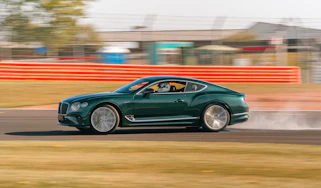
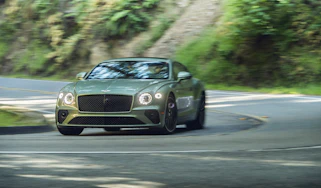
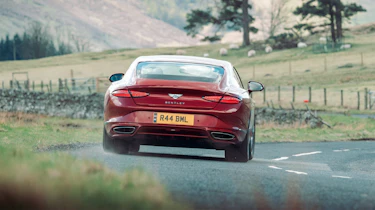
Despite all that power and torque, the Continental is never a wild ride: in all its guises it remains the epitome of a GT car as it matches opulence with a turn of performance that will whisk you to your destination at whatever pace you desire. There’s pleasing weighting to the controls too, which deliver smooth, accurate responses. The quality of the damping (all models get two-chamber air suspension) and body control make it a far more athletic drive than you might have anticipated. It’s no Caterham, but its high fidelity of chassis tuning belies its mass.
The Continental uses every chassis gizmo in the book to achieve this, including four-wheel steering, an e-diff and 48-volt active anti-roll bars. It’s not as lithe and engaging as a Ferrari Amalfi – far from it – but it feels far from as heavy as it is (2.4 tons), and there’s a reassuring clarity and precision to how it tackles a road. There’s little communication through the steering or chassis but that would be at odds with the Continental’s character – it’s a car that filters out the noise, but not to the extent that it feels totally detached.
On fast, flowing roads it glides from point to point, never requiring more than a single input to react how you need it to. In a world where ultimate performance is a mantra every car manufacturer seems to be chasing, the Conti GT brings a level of maturity that’s no less compelling or engaging.
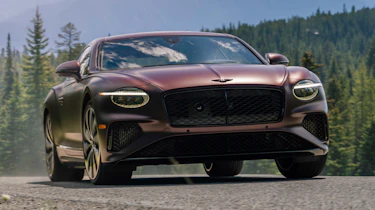
Across more challenging roads, where you might expect a car of this size and mass to shrug its broad shoulders and leave you high and dry, it works the technical armoury at its disposal hard. Brake feel isn’t always consistent (low-speed modulation can be tricky) but the stoppers have huge power, and there’s just the right amount of lean in the chassis for it to feel natural. Turn-in is rewarded with an unexpected keenness from the front axle and the rest of the car flows in unison, the rear-wheel steering managing the angle of entry and the e-diff helping determine the angles on exit if you’ve decided to play fast and loose with the stability systems (which is best done in Sport mode, which loads up a more aggressive calibration for the e-diff).
So despite being such a big car, agility remains one of the GT’s key assets. And though you’d ultimately want to be in something sharper and more expressive to attack a road – say, an Amalfi or Aston DB12 S – the Continental’s trump card is its superb levels of comfort and refinement. In Comfort mode it flows like a Range Rover with a cossetting ride and impressive isolation, all while surrounding you in an exquisite, beautifully built cabin. It’s hard to think of any rival that’s more adept at covering distance.
Interior and technology
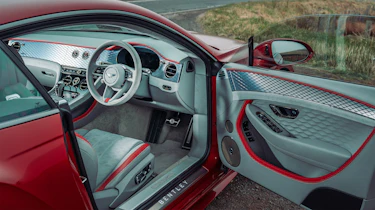
Little has changed inside the latest Continental GT compared with its predecessor, but not much needed to. It remains one of the most impressively detailed and well built interiors of any grand tourer, and easily a match for the latest from Aston Martin and Ferrari (in fact, it easily surpasses the latter in almost every department).
The cabin architecture comes from a time when not everything was operated by screens, and the ergonomics are spot on. The knurled physical controls for the climate controls, drive modes and media are very satisfying to use, and while the infotainment screen isn’t the biggest or most advanced on the market, it’s relatively intuitive. The graphics are sharp and the basic tile layout of the UI – shared with older-generation Audis – is easy to navigate.
Details in the cabin can be customised to your hearts content. You need to spend money on options, such as the party-piece rotating infotainment display, custom veneers and upholstery for it to feel its best, but the fundamentals are excellent to begin with. Even in base form, the Continental is as opulent and luxurious as you’d expect of a grand tourer.
Price and rivals
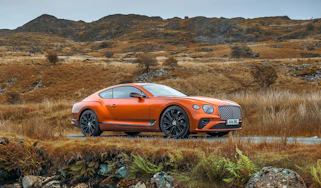
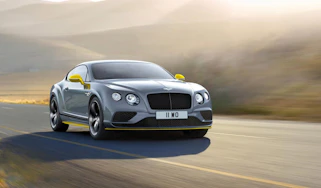
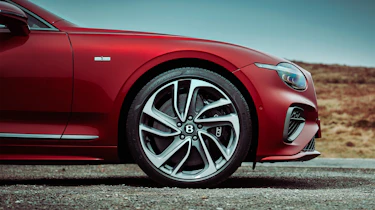
The Continental GT remains an imposing car on the road and a very special place to ride in, regardless of the journey. There are faster and more dynamic rivals but they don’t blend all of the requisite GT elements as well as the Bentley does. So it should, given the base GT starts from £202,400.
That puts it at a similar level to the Ferrari Amalfi. Maranello’s sports GT is undoubtedly more engaging and exciting than the Continental, with more of an edge to its powertrain and handling, but it’s a less graceful tourer. Still comfortable and usable, but lacking the effortless grace of the Bentley, and its exquisite interior.
Aston Martin’s new DB12 S is another alternative, bringing welcome added bite to the base car while improving on its GT credentials at the same time. As for Maserati’s GranTurismo? It simply feels a league behind in terms of chassis and engine performance, though it does come close to the Bentley’s GT remit as a comfortable four-seat coupe.
Bentley Continental GT specs
| Engine | V8, 3996cc, twin-turbo, plus 140kW electric motor |
| Power | 671bhp (combined) @ 6250rpm |
| Torque | 686lb ft (combined) |
| Weight | 2384kg (286bhp/ton) |
| Tyres | Pirelli P Zero |
| 0-62mph | 3.7sec |
| Top speed | 168mph |
| Basic price | £202,400 |